Back
Back
Problem 4.2.11
Checking the Mean Value Theorem
Which of the functions in Exercises 7–12 satisfy the hypotheses of the Mean Value Theorem on the given interval, and which do not? Give reasons for your answers.
f(x) = {x² − x, −2 ≤ x ≤−1
2x² − 3x − 3, −1 < x ≤ 0
Problem 4.7.39
Finding Indefinite Integrals
In Exercises 17–56, find the most general antiderivative or indefinite integral. You may need to try a solution and then adjust your guess. Check your answers by differentiation.
∫(−3csc²x)dx
Problem 4.1.39
Absolute Extrema on Finite Closed Intervals
In Exercises 37–40, find the function’s absolute maximum and minimum values and say where they occur.
g(θ) = θ³ᐟ⁵, −32 ≤ θ ≤ 1
Problem 4.3.33
Identifying Extrema
In Exercises 19–40:
a. Find the open intervals on which the function is increasing and those on which it is decreasing.
b. Identify the function’s local extreme values, if any, saying where they occur.
g(x) = x√8 − x²
Problem 4.4.27
In Exercises 9–66, graph the function using appropriate methods from the graphing procedures presented just before Example 9, identifying the coordinates of any local extreme points and inflection points. Then find coordinates of absolute extreme points, if any.
y = 1 / (x² - 1)
Problem 4.1.65
Theory and Examples
[Technology Exercise] Graph the functions in Exercises 63–66. Then find the extreme values of the function on the interval and say where they occur.
h(x) = |x + 2| − |x − 3|, −∞ < x < ∞
Problem 4.3.31
Identifying Extrema
In Exercises 19–40:
a. Find the open intervals on which the function is increasing and those on which it is decreasing.
b. Identify the function’s local extreme values, if any, saying where they occur.
f(x) = x − 6√(x − 1)
Problem 4.7.27
Finding Indefinite Integrals
In Exercises 17–56, find the most general antiderivative or indefinite integral. You may need to try a solution and then adjust your guess. Check your answers by differentiation.
∫(√x + ³√x) dx
Problem 4.2
Finding Extreme Values
In Exercises 1–10, find the extreme values (absolute and local) of the function over its natural domain, and where they occur.
y = 𝓍³ ― 2𝓍 + 4
Problem 4.7.71
Initial Value Problems
Solve the initial value problems in Exercises 71–90.
dy/dx = 2x − 7, y(2) = 0
Problem 4.5.26
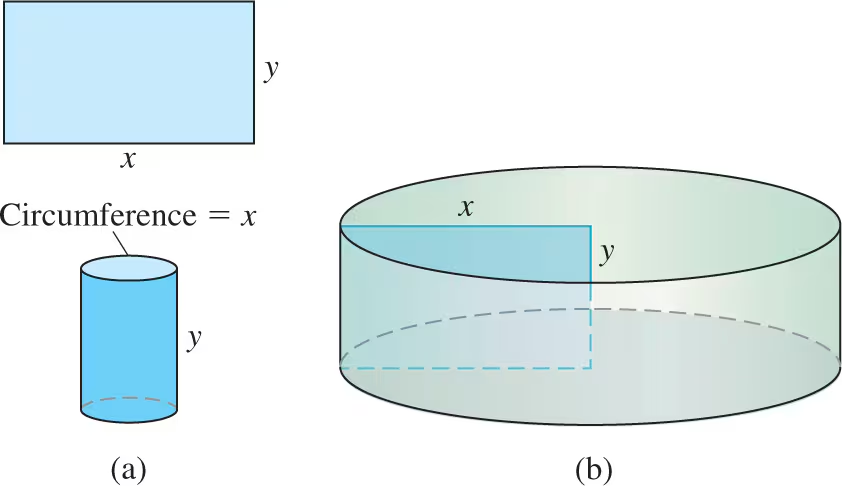
26. Constructing cylinders Compare the answers to the following two construction problems.
a. A rectangular sheet of perimeter 36 cm and dimensions x cm by y cm is to be rolled into a cylinder as shown in part (a) of the figure. What values of x and y give the largest volume?
b. The same sheet is to be revolved about one of the sides of length y to sweep out the cylinder as shown in part (b) of the figure. What values of x and y give the largest volume?
Problem 4.2.23
"Roots (Zeros) Show that the functions in Exercises 19–26 have exactly one zero
Problem 4.2.37
Finding Functions from Derivatives
In Exercises 37–40, find the function with the given derivative whose graph passes through the point P.
f'(x) = 2x − 1, P(0,0)
Problem 4.4.109
109. Suppose the derivative of the function y = f(x) is
y'=(x-1)^2(x-2).
At what points, if any, does the graph of f have a local minimum, local maximum, or
point of inflection? (Hint: Draw the sign pattern for y'.)
Problem 4.5.10
10. Catching rainwater A 1125 ft^3 open-top rectangular tank with a square base x ft on a side and y ft deep is to be built with its top flush with the ground to catch runoff water. The costs associated with the tank involve not only the material from which the tank is made but also an excavation charge proportional to the product xy.
a. If the total cost is c=5(x^2+4xy) + 10xy, what values of x and y will minimize it?
b. Give a possible scenario for the cost function in part (a).
Problem 4.2.4
Checking the Mean Value Theorem
Find the value or values of c that satisfy the equation (f(b) − f(a)) / (b − a) = f′(c) in the conclusion of the Mean Value Theorem for the functions and intervals in Exercises 1–6.
f(x) =√(x − 1), [1, 3]
Problem 4.4.8
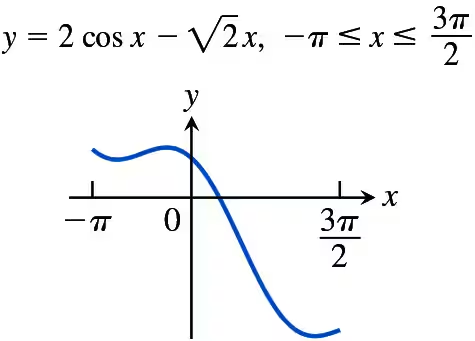
Identify the inflection points and local maxima and minima of the functions graphed in Exercises 1–8. Identify the open intervals on which the functions are differentiable and the graphs are concave up and concave down.
8. y = 2cosx - √2x, -π≤x≤3π/2
Problem 4.1.27
Absolute Extrema on Finite Closed Intervals
In Exercises 21–36, find the absolute maximum and minimum values of each function on the given interval. Then graph the function. Identify the points on the graph where the absolute extrema occur, and include their coordinates.
h(x) = ³√x, −1 ≤ x ≤ 8
Problem 4.4.77
Each of Exercises 67–88 gives the first derivative of a continuous function y=f(x). Find y'' and then use Steps 2–4 of the graphing procedure described in this section to sketch the general shape of the graph of f.
77. y' = cot(θ/2), for 0 < θ < 2π
Problem 4.1.37
Absolute Extrema on Finite Closed Intervals
In Exercises 37–40, find the function’s absolute maximum and minimum values and say where they occur.
f(x) = x⁴ᐟ³, −1 ≤ x ≤ 8
Problem 4.58
Sketch the graphs of the rational functions in Exercises 53–60.
𝓍⁴ ― 1
y = ------------------
𝓍²
Problem 4.5.45
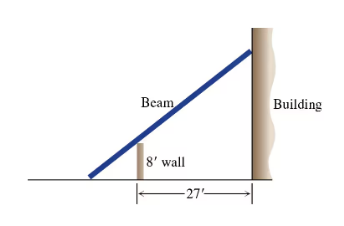
The 8-ft wall shown here stands 27 ft from the building. Find the length of the shortest straight beam that will reach to the side of the building from the ground outside the wall.
Problem 4.7.79
Initial Value Problems
Solve the initial value problems in Exercises 71–90.
dr/dθ = −π sin (πθ), r(0) = 0
Problem 4.PE.90
Initial Value Problems
Solve the initial value problems in Exercises 89–92.
dy/dx = (𝓍 + 1/𝓍)² , y(1)= 1
Problem 4.PE.83
Finding Indefinite Integrals
Find the indefinite integrals (most general antiderivatives) in Exercises 73–88. You may need to try a solution and then adjust your guess. Check your answers by differentiation.
∫ sec² s/10 ds
Problem 4.PE.75
Finding Indefinite Integrals
Find the indefinite integrals (most general antiderivatives) in Exercises 73–88. You may need to try a solution and then adjust your guess. Check your answers by differentiation.
__
∫ ( 3√ t + 4/t² ) dt
Problem 4.PE.88
Finding Indefinite Integrals
Find the indefinite integrals (most general antiderivatives) in Exercises 73–88. You may need to try a solution and then adjust your guess. Check your answers by differentiation.
∫ cos³ 𝓍/2 d𝓍
Problem 4.PE.92
Initial Value Problems
Solve the initial value problems in Exercises 89–92.
d^3 r/dt^3 = - cos t; r''(0) = r'(0) = 0 , r(0) = -1
Problem 4.PE.73
Finding Indefinite Integrals
Find the indefinite integrals (most general antiderivatives) in Exercises 73–88. You may need to try a solution and then adjust your guess. Check your answers by differentiation.
∫ (𝓍³ + 5𝓍 ―7) d𝓍
Problem 4.PE.81
Finding Indefinite Integrals
Find the indefinite integrals (most general antiderivatives) in Exercises 73–88. You may need to try a solution and then adjust your guess. Check your answers by differentiation.
∫ 𝓍³ (1 + 𝓍⁴ )⁻¹/⁴ d𝓍