Back
Back
Problem 50
In Exercises 49–52, graph each function. Then use the function’s first derivative to explain what you see.
y = 𝓍²/³ + (𝓍―1)²/³
Problem 51
Applications
Classical accounts tell us that a 170-oar trireme (ancient Greek or Roman warship) once covered 184 sea miles in 24 hours. Explain why at some point during this feat the trireme’s speed exceeded 7.5 knots (sea or nautical miles per hour).
Problem 53
Sketch the graphs of the rational functions in Exercises 53–60.
y= (x + 1) / (x - 3)
Problem 55
Sketch the graphs of the rational functions in Exercises 53–60.
y = (x2 + 1) / x
Problem 56
In Exercises 9–66, graph the function using appropriate methods from the graphing procedures presented just before Example 9, identifying the coordinates of any local extreme points and inflection points. Then find coordinates of absolute extreme points, if any.
56. y = x² + 2/x
Problem 60
In Exercises 9–66, graph the function using appropriate methods from the graphing procedures presented just before Example 9, identifying the coordinates of any local extreme points and inflection points. Then find coordinates of absolute extreme points, if any.
60. y = 5 / (x⁴ + 5)
Problem 61
The sum of two nonnegative numbers is 36. Find the numbers if
a. the difference of their square roots is to be as large as possible.
b. the sum of their square roots is to be as large as possible.
Problem 63
An isosceles triangle has its vertex at the origin and its base parallel to the x-axis with the vertices above the axis on the curve y = 27 - x2. Find the largest area the triangle can have.
Problem 64
A customer has asked you to design an open-top rectangular stainless steel vat. It is to have a square base and a volume of 32 ft³ , to be welded from quarter-inch plate, and to weigh no more than necessary. What dimensions do you recommend?
Problem 67
Your company can manufacture x hundred grade A tires and y hundred grade B tires a day, where 0 ≤ x ≤ 4 and y = (40 - 10x)/(5-x). Your profit on a grade A tire is twice your profit on a grade B tire. What is the most profitable number of each kind to make?
Problem 68a
Particle motion The positions of two particles on the s-axis are s₁ = cos t and s₂ = cos (t + π/4) .
a. What is the farthest apart the particles ever get?
Problem 68b
Particle motion The positions of two particles on the s-axis are s₁ = cos t and s₂ = cos (t + π/4) .
b. When do the particles collide?
Problem 68c
Theory and Examples
Sketch the graph of a differentiable function y = f(x) that has a local maxima at (1, 1) and (3, 3)
Problem 68d
Theory and Examples
Sketch the graph of a differentiable function y = f(x) that has a local minima at (1, 1) and (3, 3).
Problem 70
The ladder problem What is the approximate length (in feet) of the longest ladder you can carry horizontally around the corner of the corridor shown here? Round your answer down to the nearest foot.
Problem 71
Let ƒ(x) = 3x - x³ . Show that the equation ƒ(𝓍) = -4 has a solution in the interval [2,3] and use Newton’s method to find it.
Problem 90
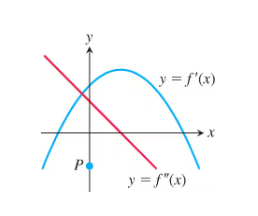
Each of Exercises 89–92 shows the graphs of the first and second derivatives of a function y=f(x). Copy the picture and add to it a sketch of the approximate graph of f, given that the graph passes through the point P.
Problem 96
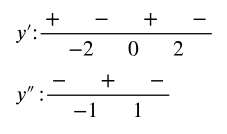
Sketch the graph of a twice-differentiable function y=f(x) that passes through the points (-2,2), (-1,1), (0,0),(1,1), and (2,2) and whose first two derivatives have the following sign patterns.
Problem 103
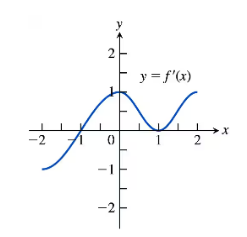
103. A function f(x) has domain (-2, 2). The graph below is a plot of the derivative of f, not a plot of f itself. In other words, this is a graph of y = f'(x). Either use this graph to determine on which intervals the graph of f is concave up and on which intervals the graph of f is concave down, or explain why this information cannot be determined from the graph.
Problem 106b
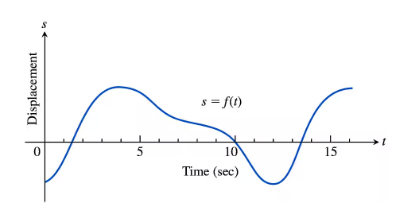
106. Motion Along a Line The graphs in Exercises 105 and 106 show the position s=f(t) of an object moving up and down on a coordinate line. At approximately what times is the (b) velocity equal to zero?
<IMAGE>
Problem 123
In Exercises 121–124, find the inflection points (if any) on the graph of the function and the coordinates of the points on the graph where the function has a local maximum or local minimum value. Then graph the function in a region large enough to show all these points simultaneously. Add to your picture the graphs of the function’s first and second derivatives. How are the values at which these graphs intersect the x-axis related to the graph of the function? In what other ways are the graphs of the derivatives related to the graph of the function?
123. y=(4/5)x^5+16x^2-25
Problem 125
Graph f(x) = 2x^4 -4x^2 + 1 and its first two derivatives together. Comment on the behavior of f in relation to the signs and values of f' and f".
Problem 126
Graph f(x) = x cos x and its second derivative together for 0 ≤ x ≤ 2pi. Comment on the behavior of the graph of f in relation to the signs and values of f".