Identify the problem as the product of two binomials: \((x + 7y)(3x - 5y)\).
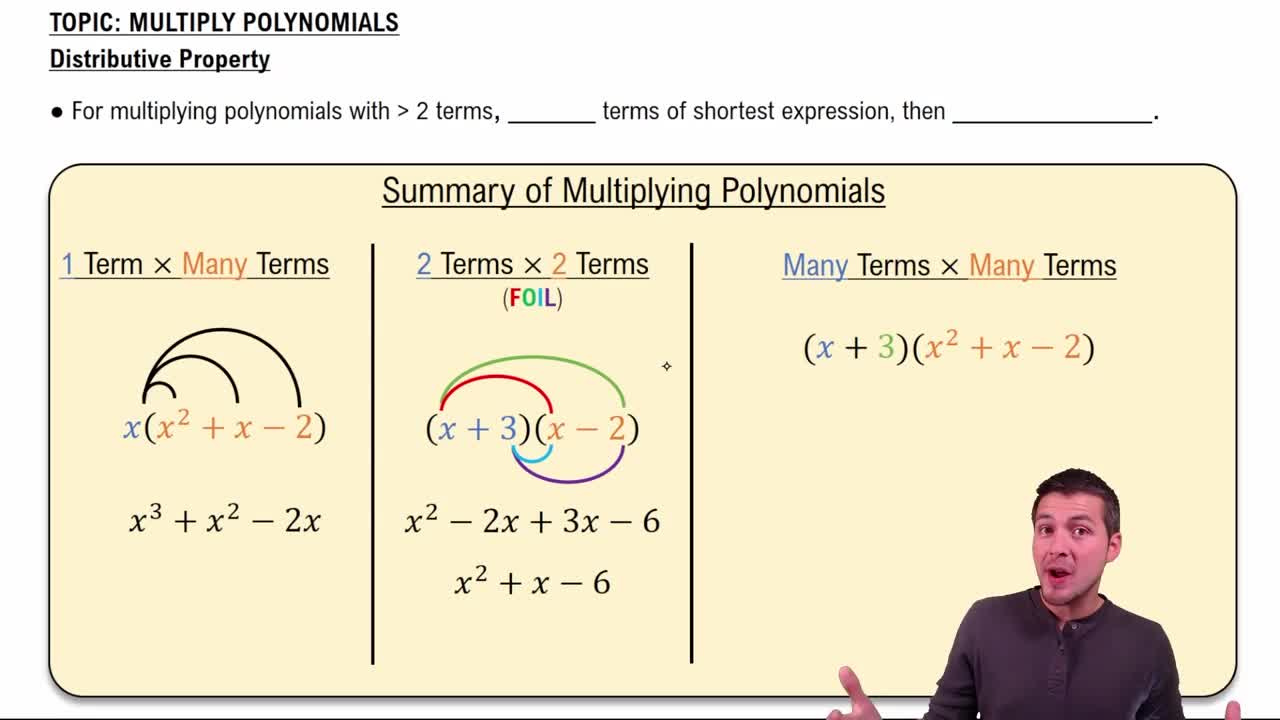
Apply the distributive property (also known as FOIL method) to multiply each term in the first binomial by each term in the second binomial: First, Outer, Inner, Last.
Multiply the First terms: \(x \times 3x = 3x^{2}\).
Multiply the Outer terms: \(x \times (-5y) = -5xy\).
Multiply the Inner terms: \(7y \times 3x = 21xy\), and multiply the Last terms: \(7y \times (-5y) = -35y^{2}\). Then combine like terms \(-5xy\) and \$21xy$.
Verified video answer for a similar problem:
This video solution was recommended by our tutors as helpful for the problem above
Video duration:
1m
Play a video:
0 Comments
Key Concepts
Here are the essential concepts you must grasp in order to answer the question correctly.
Distributive Property
The distributive property allows you to multiply each term inside one parenthesis by each term inside the other. It is essential for expanding expressions like (x + 7y)(3x - 5y) by distributing each term in the first binomial across the second.
Multiply Polynomials Using the Distributive Property
Combining Like Terms
After expanding the product, you combine like terms, which are terms with the same variables raised to the same powers. This simplifies the expression into its simplest form, making it easier to interpret or use in further calculations.
When multiplying terms like x and 3x or 7y and -5y, multiply the coefficients (numbers) and apply the laws of exponents to variables. For example, x * x = x², and coefficients multiply normally, which is crucial for correctly expanding the product.