In Exercises 69–82, multiply using the rule for the product of the sum and difference of two terms.(2 − y⁵)(2 + y⁵)
Verified step by step guidance
1
Recognize that the expression \((2 - y^5)(2 + y^5)\) is in the form of \((a - b)(a + b)\), which is a difference of squares.
Recall the formula for the difference of squares: \((a - b)(a + b) = a^2 - b^2\).
Identify \(a\) and \(b\) in the expression: here, \(a = 2\) and \(b = y^5\).
Apply the difference of squares formula: substitute \(a = 2\) and \(b = y^5\) into \(a^2 - b^2\).
Calculate \(a^2\) and \(b^2\): \(a^2 = 2^2\) and \(b^2 = (y^5)^2\).
Verified video answer for a similar problem:
This video solution was recommended by our tutors as helpful for the problem above
Video duration:
4m
Play a video:
0 Comments
Key Concepts
Here are the essential concepts you must grasp in order to answer the question correctly.
Product of Sum and Difference
The product of the sum and difference of two terms follows the formula (a - b)(a + b) = a² - b². This identity simplifies the multiplication of expressions that are structured as a difference and a sum, allowing for a straightforward calculation by squaring the first term and subtracting the square of the second term.
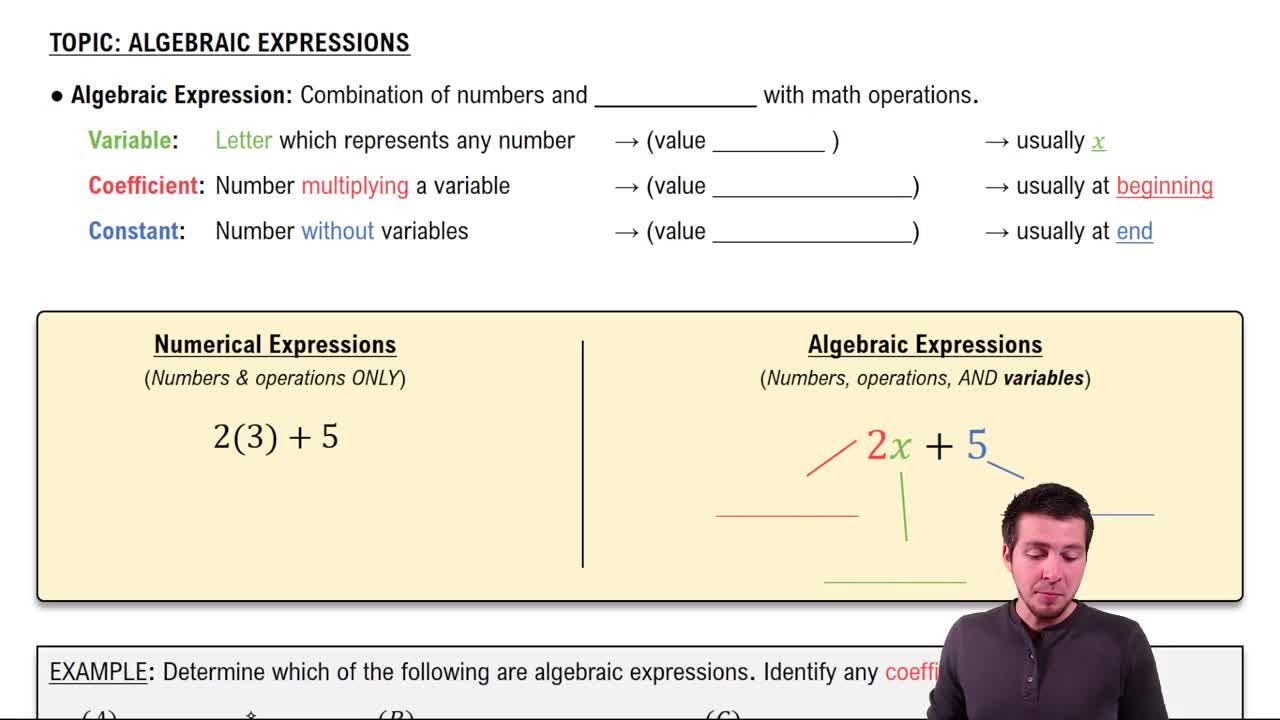
Algebraic expressions consist of numbers, variables, and operations. In the given expression (2 - y⁵)(2 + y⁵), the terms 2 and y⁵ are variables that can represent any number. Understanding how to manipulate these expressions is crucial for performing operations like multiplication and simplification.
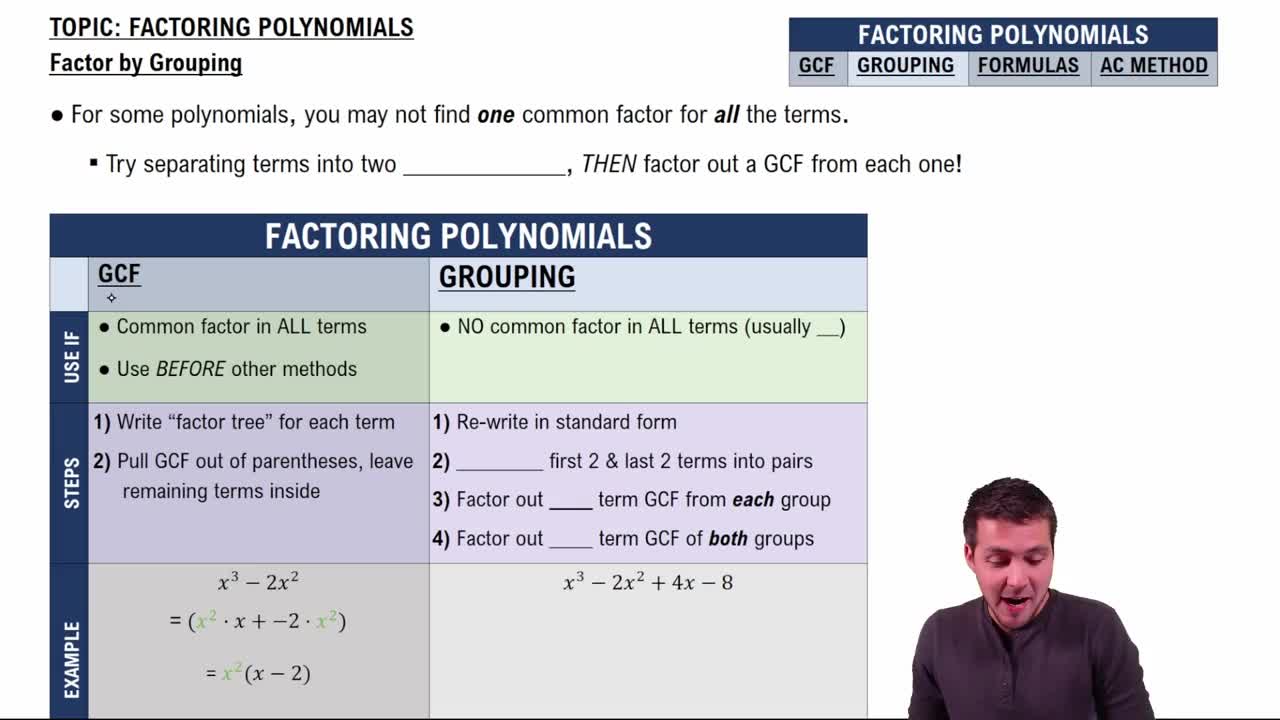
Factoring involves rewriting an expression as a product of its factors, while expanding is the process of distributing and simplifying a product. In this case, recognizing the structure of the expression allows for efficient multiplication without needing to expand each term individually, thus saving time and reducing complexity.

 4:55 minutes
 Verified step by step guidance
 03:41
03:41