Perform the indicated operations. Indicate the degree of the resulting polynomial.
Verified step by step guidance
1
Identify the polynomials to be added: \( (7x^2 - 8xy + y^2) \) and \( (-8x^2 - 9xy - 4y^2) \).
Group like terms together: combine the \(x^2\) terms, the \(xy\) terms, and the \(y^2\) terms separately.
Add the coefficients of the like terms: for \(x^2\), add \$7\( and \)-8\(; for \)xy\(, add \)-8\( and \)-9\(; for \)y^2\(, add \)1\( and \)-4$.
Write the resulting polynomial by combining the sums of the like terms into a single expression.
Determine the degree of the resulting polynomial by identifying the term with the highest total exponent sum (for example, \(x^2\) has degree 2, \(xy\) has degree 2, etc.).
Verified video answer for a similar problem:
This video solution was recommended by our tutors as helpful for the problem above
Video duration:
1m
Play a video:
0 Comments
Key Concepts
Here are the essential concepts you must grasp in order to answer the question correctly.
Polynomial Addition
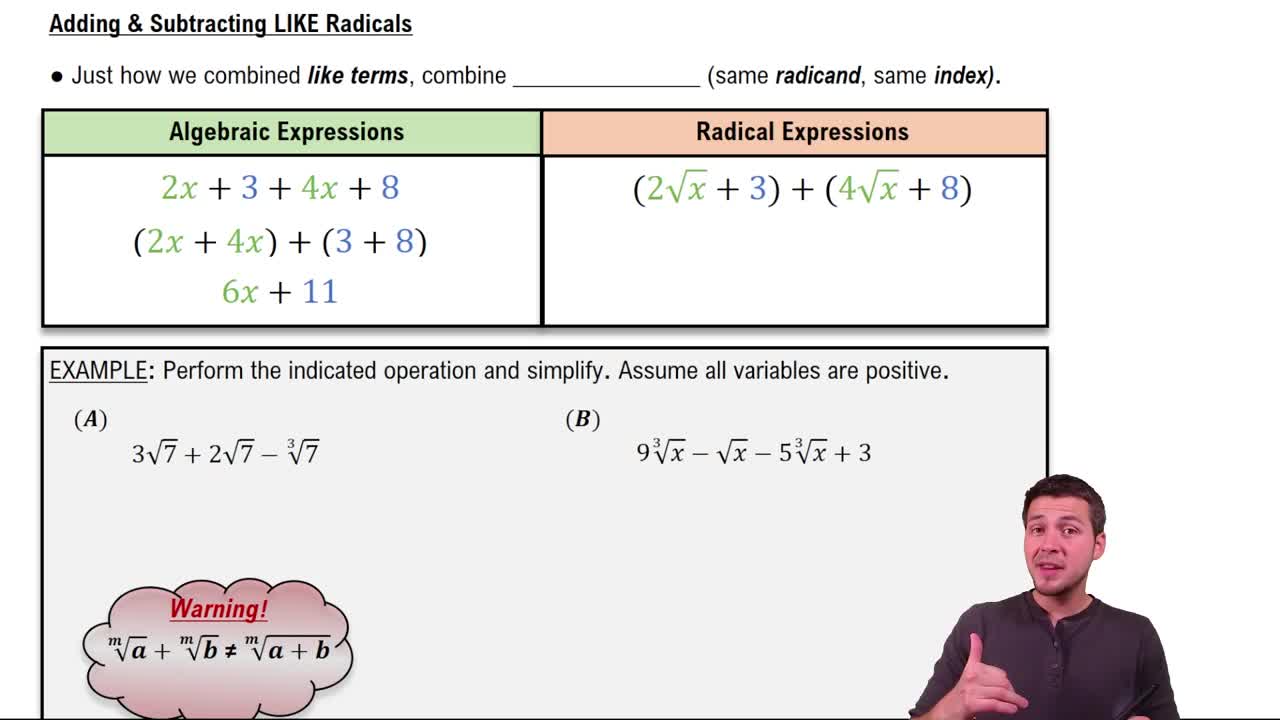
Polynomial addition involves combining like terms, which are terms with the same variables raised to the same powers. To add polynomials, add the coefficients of like terms while keeping the variable parts unchanged. This process simplifies the expression into a single polynomial.
Like terms are terms in a polynomial that have identical variable parts and exponents. For example, 7x² and -8x² are like terms because both have x raised to the second power. Recognizing like terms is essential for correctly performing addition or subtraction of polynomials.
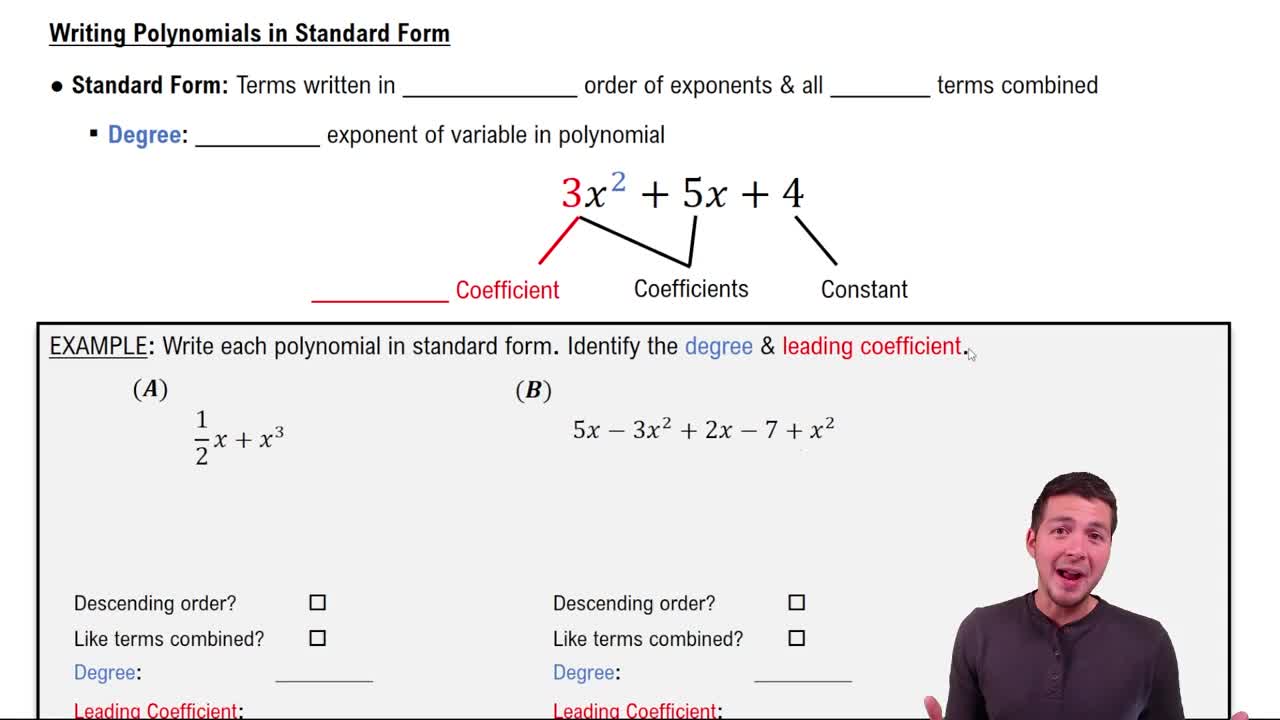
The degree of a polynomial is the highest sum of exponents of variables in any single term. For example, in the term 7x², the degree is 2, and in -8xy, the degree is 1+1=2. After simplifying, the degree helps classify the polynomial and understand its behavior.

 1:58 minutes
 Verified step by step guidance
 05:13
05:13