Use the graph of y = f(x) to graph each function g. g(x) = 2f(x)
Verified step by step guidance
1
Step 1: Observe the graph of y = f(x). It is a horizontal line segment from (1, -3) to (4, -3), meaning the function f(x) is constant and equal to -3 for all x in the interval [1, 4].
Step 2: Understand the transformation g(x) = 2f(x). This means that the values of f(x) are multiplied by 2 to produce g(x). Mathematically, g(x) = 2 * (-3) = -6 for all x in the interval [1, 4].
Step 3: Determine the new graph of g(x). Since g(x) is constant and equal to -6, the graph of g(x) will also be a horizontal line segment, but at y = -6 instead of y = -3.
Step 4: Plot the new line segment for g(x). The endpoints of the line segment will remain the same in terms of x-coordinates, so the new line segment will extend from (1, -6) to (4, -6).
Step 5: Label the graph appropriately. Indicate that the new graph represents g(x) = 2f(x), and ensure the horizontal line segment is clearly drawn at y = -6 between x = 1 and x = 4.
Verified video answer for a similar problem:
This video solution was recommended by our tutors as helpful for the problem above
Video duration:
1m
Play a video:
0 Comments
Key Concepts
Here are the essential concepts you must grasp in order to answer the question correctly.
Function Transformation
Function transformation refers to the process of altering the graph of a function through various operations, such as vertical or horizontal shifts, stretches, or reflections. In this case, the function g(x) = 2f(x) represents a vertical stretch of the original function f(x) by a factor of 2, which means that every output value of f(x) is multiplied by 2.
Graphing functions involves plotting points on a coordinate plane based on the function's input-output relationship. For the function g(x) = 2f(x), the graph can be derived from the graph of f(x) by taking each y-coordinate of f(x) and multiplying it by 2, effectively doubling the height of the graph while keeping the x-coordinates the same.
Horizontal lines in a graph represent constant functions where the output value remains the same regardless of the input. In the provided graph, f(x) is a horizontal line at y = -3 between x = 1 and x = 4. When transforming this line to g(x) = 2f(x), the new line will be at y = -6, maintaining its horizontal nature but at a different vertical position.

 1:15 minutes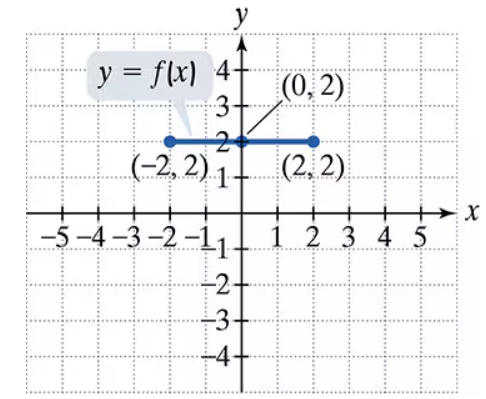
 Verified step by step guidance
 4:22
4:22