In Exercises 1-16, use the graph of y = f(x) to graph each function g. g(x) = -f(2x) - 1
Verified step by step guidance
1
Step 1: Analyze the given graph of y = f(x). The graph shows a horizontal line segment with endpoints at (1, -3) and (4, -3). This indicates that f(x) is constant and equal to -3 for x in the interval [1, 4].
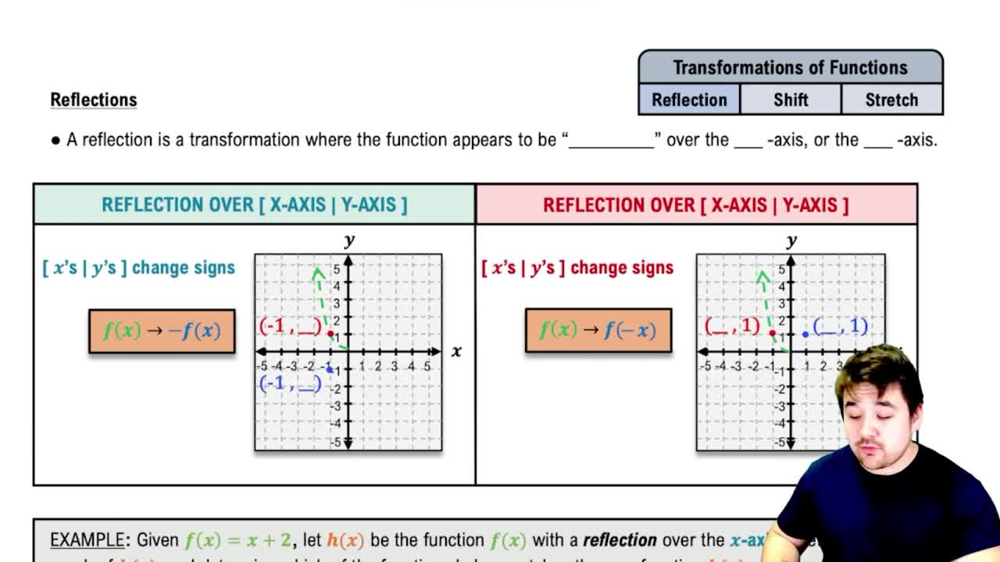
Step 2: Understand the transformation g(x) = -f(2x) - 1. The function g(x) involves three transformations: (1) horizontal compression by a factor of 2 due to '2x', (2) reflection across the x-axis due to the negative sign in front of f, and (3) vertical shift downward by 1 due to '-1'.
Step 3: Apply the horizontal compression. The x-values of the original graph are scaled by a factor of 1/2. The interval [1, 4] becomes [0.5, 2].
Step 4: Apply the reflection across the x-axis. Since f(x) = -3, the reflection changes the value to 3. Thus, the new function values are 3 for the interval [0.5, 2].
Step 5: Apply the vertical shift downward by 1. Subtract 1 from the reflected values, resulting in g(x) = 2 for the interval [0.5, 2]. The graph of g(x) is a horizontal line segment at y = 2 between x = 0.5 and x = 2.
Verified video answer for a similar problem:
This video solution was recommended by our tutors as helpful for the problem above
Video duration:
2m
Play a video:
0 Comments
Key Concepts
Here are the essential concepts you must grasp in order to answer the question correctly.
Function Transformation
Function transformations involve altering the graph of a function through shifts, stretches, or reflections. In this case, the function g(x) = -f(2x) - 1 represents a horizontal compression by a factor of 2, a reflection across the x-axis, and a downward shift by 1 unit. Understanding these transformations is crucial for accurately graphing the new function based on the original function f(x).
Horizontal compression occurs when the input of a function is multiplied by a factor greater than 1, which effectively 'squeezes' the graph towards the y-axis. For g(x) = -f(2x), the factor of 2 compresses the graph of f(x) horizontally, meaning that points on the graph of f(x) will be closer together on the x-axis in g(x). This concept is essential for determining the new x-coordinates of the transformed function.
A reflection across the x-axis occurs when the output of a function is multiplied by -1. In the function g(x) = -f(2x), this reflection means that all y-values of f(x) are inverted, resulting in points that are symmetrically opposite to the original points with respect to the x-axis. This transformation is key to understanding how the graph of g(x) will appear compared to f(x).

 2:03 minutes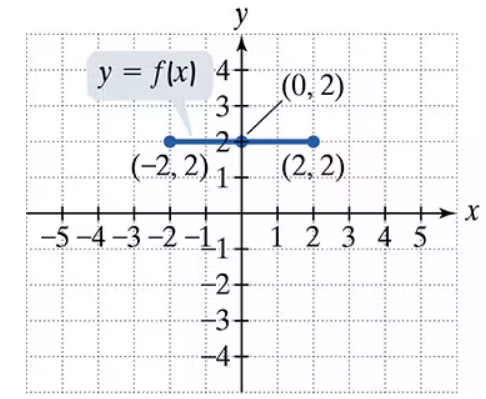
 Verified step by step guidance
 4:22
4:22