
You have cracked a secret code that uses elemental symbols to spell words. The code uses numbers to designate the elemental symbols. Each number is the sum of the atomic number and the highest principal quantum number of the highest occupied orbital of the element whose symbol is to be used. The message may be written forward or backward. Decode the following messages: a. 10, 12, 58, 11, 7, 44, 63, 66
Ch.9 - Periodic Properties of the Elements

Chapter 9, Problem 111
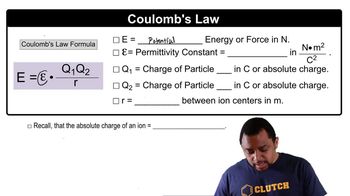
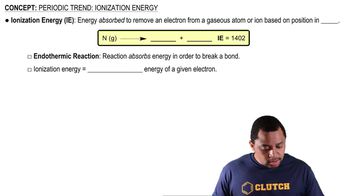
Use Coulomb's law to calculate the ionization energy in kJ/mol of an atom composed of a proton and an electron separated by 110.00 pm. What wavelength of light has sufficient energy to ionize the atom?
Verified step by step guidance1
Identify the formula for Coulomb's law: \( F = \frac{k \cdot |q_1 \cdot q_2|}{r^2} \), where \( k \) is Coulomb's constant, \( q_1 \) and \( q_2 \) are the charges of the proton and electron, and \( r \) is the separation distance.
Calculate the potential energy \( U \) using the formula \( U = \frac{k \cdot |q_1 \cdot q_2|}{r} \). This energy is the ionization energy for one atom.
Convert the ionization energy from joules to kJ/mol by multiplying by Avogadro's number \( 6.022 \times 10^{23} \) and converting from joules to kilojoules.
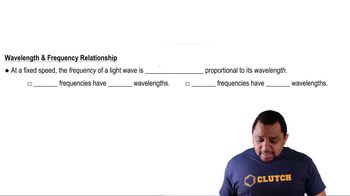
Use the energy-wavelength relationship \( E = \frac{hc}{\lambda} \) to find the wavelength \( \lambda \) of light that has sufficient energy to ionize the atom, where \( h \) is Planck's constant and \( c \) is the speed of light.
Solve for \( \lambda \) by rearranging the equation to \( \lambda = \frac{hc}{E} \), using the ionization energy calculated in the previous steps.

Verified video answer for a similar problem:
This video solution was recommended by our tutors as helpful for the problem above.
Video duration:
15mWas this helpful?
Key Concepts
Here are the essential concepts you must grasp in order to answer the question correctly.
Coulomb's Law
Coulomb's Law describes the electrostatic interaction between charged particles. It states that the force between two charges is directly proportional to the product of the magnitudes of the charges and inversely proportional to the square of the distance between them. This principle is essential for calculating the potential energy of an electron in an atom, which is crucial for determining ionization energy.
Recommended video:
Guided course
Coulomb's Law Concept 2
Ionization Energy
Ionization energy is the amount of energy required to remove an electron from an atom or ion in its gaseous state. It is typically measured in kJ/mol and reflects the strength of the attraction between the electron and the nucleus. Understanding ionization energy is vital for predicting how easily an atom can lose an electron and thus its reactivity.
Recommended video:
Guided course
Ionization Energy
Energy-Wavelength Relationship
The energy of a photon is inversely related to its wavelength, described by the equation E = hc/λ, where E is energy, h is Planck's constant, c is the speed of light, and λ is the wavelength. This relationship is important for determining the wavelength of light needed to provide sufficient energy to ionize an atom, as it allows us to calculate the wavelength corresponding to the ionization energy obtained from Coulomb's Law.
Recommended video:
Guided course
Frequency-Wavelength Relationship
Related Practice
Textbook Question
2960
views
Textbook Question
Consider the elements: Na, Mg, Al, Si, P. b. Which element has the smallest atomic radius?
1578
views
Textbook Question
The elements with atomic numbers 35 and 53 have similar chemical properties. Based on their electronic configurations, predict the atomic number of a heavier element that also should share these chemical properties.
818
views
1
rank
Textbook Question
Consider the elements: Na, Mg, Al, Si, P. c. Which element is least metallic?
539
views
Textbook Question
Consider the elements: B, C, N, O, F. d. Which element has three unpaired electrons?
350
views
