Ch.8 - Basic Concepts of Chemical Bonding
Brown - Chemistry: The Central Science 14th Edition
Brown14th EditionChemistry: The Central ScienceISBN: 9780134414232Not the one you use?Change textbook
Chapter 8, Problem 86c,d

The substance chlorine monoxide, ClO(g), is important in atmospheric processes that lead to depletion of the ozone layer. The ClO molecule has an experimental dipole moment of 1.24 D, and the Cl—O bond length is 160 pm. (c) Using formal charges as a guide, propose the dominant Lewis structure for the molecule. (g), is important in atmospheric processes that lead to depletion of the ozone layer. The ClO molecule has an experimental dipole moment of 1.24 D, and the Cl—O bond length is 160 pm. (d) The anion ClO exists. What is the formal charge on the Cl for the best Lewis structure for ClO-?

Verified step by step guidance
1
Step 1: To propose the dominant Lewis structure for ClO, start by determining the total number of valence electrons. Chlorine (Cl) has 7 valence electrons, and oxygen (O) has 6 valence electrons. Therefore, ClO has a total of 13 valence electrons.
Step 2: Arrange the atoms with Cl and O bonded together. Place the remaining electrons around the atoms to satisfy the octet rule, starting with the more electronegative atom, which is oxygen.
Step 3: Calculate the formal charges for each atom in the proposed Lewis structure. The formal charge is calculated using the formula: \( \text{Formal Charge} = \text{Valence Electrons} - \text{Non-bonding Electrons} - \frac{1}{2} \times \text{Bonding Electrons} \). Adjust the structure to minimize formal charges.
Step 4: For the ClO- anion, add an extra electron to the total valence electrons, making it 14. Construct the Lewis structure with Cl and O bonded, and distribute the electrons to satisfy the octet rule.
Step 5: Calculate the formal charge on Cl in ClO-. Use the formula for formal charge and ensure that the structure with the lowest formal charges is chosen. The formal charge on Cl should be calculated considering the extra electron in the anion.

Verified video answer for a similar problem:

This video solution was recommended by our tutors as helpful for the problem above.
Video duration:
3m
Was this helpful?

Key Concepts

Here are the essential concepts you must grasp in order to answer the question correctly.

Lewis Structures

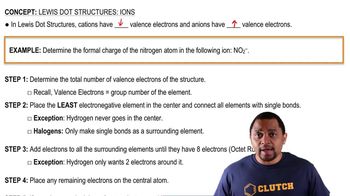
Lewis structures are diagrams that represent the bonding between atoms in a molecule and the lone pairs of electrons that may exist. They help visualize the arrangement of electrons and the connectivity of atoms, allowing chemists to predict molecular geometry and reactivity. In the case of ClO, drawing the Lewis structure involves determining how many valence electrons are available and how they are distributed among the chlorine and oxygen atoms.
Recommended video:
Guided course
04:28
Lewis Dot Structures: Ions

Formal Charge

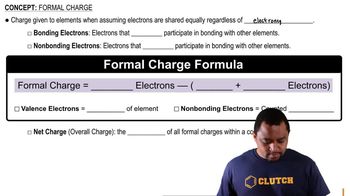
Formal charge is a theoretical charge assigned to an atom in a molecule, calculated based on the number of valence electrons, the number of non-bonding electrons, and the number of bonds formed. It helps in evaluating the most stable Lewis structure by minimizing the formal charges across the molecule. For ClO and its anion ClO<sup>-</sup>, calculating the formal charge on chlorine involves considering its valence electrons and how they are shared or unshared in the structure.
Recommended video:
Guided course
01:53
Formal Charge

Dipole Moment

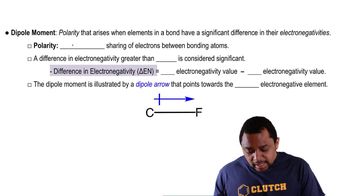
The dipole moment is a measure of the separation of positive and negative charges in a molecule, indicating its polarity. It is influenced by the electronegativity of the atoms involved and the geometry of the molecule. In ClO, the dipole moment of 1.24 D suggests that there is a significant difference in electronegativity between chlorine and oxygen, leading to a polar bond that affects the molecule's behavior in atmospheric processes.
Recommended video:
Guided course
01:25
Dipole Moment
Related Practice
Textbook Question

Consider the collection of nonmetallic elements O, P, Te, I, and B. (a) Which two would form the most polar single bond?

413
views

Textbook Question

A major challenge in implementing the 'hydrogen economy' is finding a safe, lightweight, and compact way of storing hydrogen for use as a fuel. The hydrides of light metals are attractive for hydrogen storage because they can store a high weight percentage of hydrogen in a small volume. For example, NaAlH4 can release 5.6% of its mass as H2 upon decomposing to NaH(s), Al(s), and H2(g). NaAlH4 possesses both covalent bonds, which hold polyatomic anions together, and ionic bonds. (c) Based on electronegativity differences, predict the identity of the polyatomic anion. Draw a Lewis structure for this ion.

424
views
Textbook Question

(c) The measured dipole moment of BrCl is 0.57 D. If you assume the bond length in BrCl is the sum of the atomic radii, what are the partial charges on the atoms in BrCl using the experimental dipole moment?

951
views
1
rank
Textbook Question

Consider the collection of nonmetallic elements: B, As, O, and I. (d) Which element would likely to participate in two covalent bonds?

1
views
Textbook Question

The substance chlorine monoxide, ClO(g), is important in atmospheric processes that lead to depletion of the ozone layer. The ClO molecule has an experimental dipole moment of 1.24 D, and the Cl—O bond length is 160 pm. (b) Based on the electronegativities of the elements, which atom would you expect to have a partial negative charge in the ClO molecule?

987
views
Textbook Question

(b) Using these partial charges and the atomic radii given in Figure 7.8, estimate the dipole moment of the molecule.

881
views