
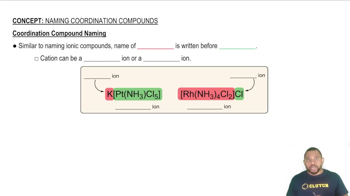
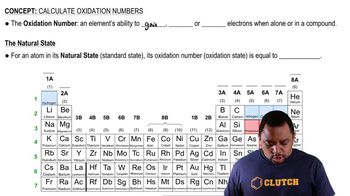
What is the name of the compound [Fe(H2O)5(SCN)]Cl2?
(a) pentaaquathiocyanatoiron(III) chloride
(b) pentaaquachlorothiocyanato iron(III)
(c) pentaaquathiocyanatoiron(III) dichloride
(d) pentaaquathiocyanatoiron(II) chloride
McMurry 8th Edition
Ch.21 - Transition Elements and Coordination Chemistry
Problem 21.79a
Verified step by step guidance
What is the name of the compound [Fe(H2O)5(SCN)]Cl2?
(a) pentaaquathiocyanatoiron(III) chloride
(b) pentaaquachlorothiocyanato iron(III)
(c) pentaaquathiocyanatoiron(III) dichloride
(d) pentaaquathiocyanatoiron(II) chloride
Nickel(II) complexes with the formula NiX2L2, where X− is Cl− or N-bonded NCS− and L is the monodentate triphenylphosphine ligand P(C6H5)3, can be square planar or tetrahedral.
(a) Draw crystal field energy-level diagrams for a square planar and a tetrahedral nickel(II) complex, and show the population of the orbitals.
Draw a crystal field energy-level diagram, and predict the number of unpaired electrons for each of the following:
(a) [Mn(H2O)6]2+
Cobalt(III) trifluoroacetylacetonate, Co(tfac)3, is a sixc oordinate, octahedral metal chelate in which three planar, bidentate tfac ligands are attached to a central Co atom:
(a) Draw all possible diastereoisomers and enantiomers of Co(tfac)3.
Which of the following complexes are diamagnetic?
(a) [Ni(H2O)6]2+
(b) [Co(CN)6]3-
(c) [HgI4]2- (tetrahedral)
(d) [Cu(NH3)4]2+ (square planar)
Classify the following ligands as monodentate, bidentate, tri-dentate, or tetradentate. Which can form chelate rings?
(a)
(b)
(c)
(d)