
Ch.21 - Transition Elements and Coordination Chemistry
McMurry - Chemistry 8th Edition
McMurry8th EditionChemistryISBN: 9781292336145Not the one you use?Change textbook
Chapter 21, Problem 21.115

Which of the following complexes are diamagnetic?
(a) [Ni(H2O)6]2+
(b) [Co(CN)6]3-
(c) [HgI4]2- (tetrahedral) 
(d) [Cu(NH3)4]2+ (square planar) 

Verified step by step guidance
1
Identify the oxidation state and electron configuration of the central metal ion in each complex.
Determine the geometry of each complex and the type of ligands involved (strong field or weak field).
Apply crystal field theory to determine the electron distribution in the d-orbitals for each complex.
Check for unpaired electrons in the d-orbitals to determine if the complex is paramagnetic or diamagnetic.
Conclude which complexes are diamagnetic based on the absence of unpaired electrons.

Verified video answer for a similar problem:

This video solution was recommended by our tutors as helpful for the problem above.
Was this helpful?

Key Concepts

Here are the essential concepts you must grasp in order to answer the question correctly.

Magnetism in Coordination Complexes

Magnetism in coordination complexes is determined by the presence of unpaired electrons. A complex is diamagnetic if all its electrons are paired, resulting in no net magnetic moment. Conversely, if there are unpaired electrons, the complex is paramagnetic. Understanding the electron configuration and the ligand field theory helps predict the magnetic properties of these complexes.
Recommended video:
Guided course
00:43
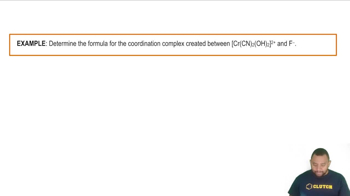
Coordination Complexes Example

Crystal Field Theory

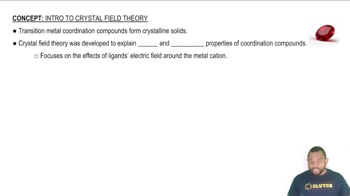
Crystal Field Theory (CFT) explains how the arrangement of ligands around a central metal ion affects its electron distribution and energy levels. Ligands can cause the d-orbitals of the metal to split into different energy levels, influencing whether electrons are paired or unpaired. The geometry of the complex (e.g., octahedral, tetrahedral) plays a crucial role in this splitting and thus in determining the magnetic properties.
Recommended video:
Guided course
01:18
The study of ligand-metal interactions helped to form Ligand Field Theory which combines CFT with MO Theory.

Ligand Field Strength

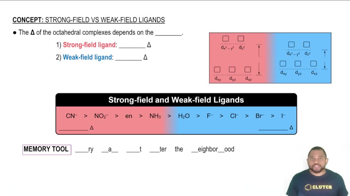
Ligand field strength refers to the ability of a ligand to influence the energy levels of the d-orbitals in a metal complex. Strong field ligands, such as CN⁻, cause greater splitting of the d-orbitals, often leading to pairing of electrons and resulting in diamagnetism. In contrast, weak field ligands, like H₂O, may not cause sufficient splitting, allowing unpaired electrons and resulting in paramagnetism.
Recommended video:
Guided course
02:40
Strong-Field Ligands result in a large Δ and Weak-Field Ligands result in a small Δ.
Related Practice
Textbook Question

Draw a crystal field energy-level diagram for a square planar complex, and explain why square planar geometry is especially common for d8 complexes.

109
views
Textbook Question

Predict the crystal field energy-level diagram for a square pyramidal ML5 complex that has two ligands along the axes but only one ligand along the z axis. Your diagram should be intermediate between those for an octahedral ML6 complex and a square planar ML4 complex.

109
views
Textbook Question

What is a racemic mixture? Does it affect plane-polarized light? Explain.

87
views
Textbook Question

The amount of paramagnetism for a first-series transition metal complex is related approximately to its spin-only magnetic moment. The spin-only value of the magnetic moment in units of Bohr magnetons (BM) is given by sqrt(n(n + 2)), where n is the number of unpaired electrons. Calculate the spin-only value of the magnetic moment for the 2+ ions of the first-series transition metals (except Sc) in octahedral complexes with (a) weak-field ligands and (b) strong-field ligands. For which electron configurations can the magnetic moment distinguish between high-spin and low-spin electron configurations?

99
views
Textbook Question

What is the systematic name for each of the following coordination compounds? 

(c) [Co(NH3)4Br2]Br

(d) Cu(gly)2

170
views
Textbook Question

What is the name of the compound [Fe(H2O)5(SCN)]Cl2? 

(a) pentaaquathiocyanatoiron(III) chloride 

(b) pentaaquachlorothiocyanato iron(III) 

(c) pentaaquathiocyanatoiron(III) dichloride

(d) pentaaquathiocyanatoiron(II) chloride

491
views