

In an experiment to study the photoelectric effect, a scientist measures the kinetic energy of ejected electrons as a function of the frequency of radiation hitting a metal surface. She obtains the following plot. The point labeled 'n0' corresponds to light with a wavelength of 542 nm. (a) What is the value of n0 in s - 1?

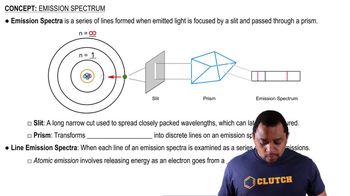
Certain elements emit light of a specific wavelength when they are burned or heated in a non-luminous flame. Historically, chemists used such emission wavelengths to determine whether specific elements were present in a sample. Some characteristic wavelengths for a few of the elements are given in the following table:
Ag 328.1 nm Fe 372.0 nm
Au 267.6 nm K 404.7 nm
Ba 455.4 nm Mg 285.2 nm
Ca 422.7 nm Na 589.6 nm
Cu 324.8 nm Ni 341.5 nm
(c) When burned, a sample of an unknown substance is found to emit light of frequency 6.58 * 1014 s-1. Which of these elements is probably in the sample?
Verified step by step guidance
Verified video answer for a similar problem:
Key Concepts
Emission Spectra
Wavelength and Frequency Relationship
Identifying Elements through Spectroscopy
In August 2011, the Juno spacecraft was launched from Earth with the mission of orbiting Jupiter, arriving nearly five years later in July of 2016. The distance between the two planets varies depending on where each planet is in its orbit, but at the closest, the distance between Jupiter and Earth is 391 million miles. What is the minimum amount of time it takes for a transmitted signal from Juno to reach the Earth?
Consider the two waves shown here, which we will consider to represent two electromagnetic radiations: (b) What is the frequency of wave A?
Consider the two waves shown here, which we will consider to represent two electromagnetic radiations: (a) What is the wavelength of wave A?
The following electron configurations represent excited states. Identify the element and write its ground-state condensed electron configuration. (b) 3Ar44s13d104p25p1
