
Ch.21 - Transition Elements and Coordination Chemistry
McMurry - Chemistry 8th Edition
McMurry8th EditionChemistryISBN: 9781292336145Not the one you use?Change textbook
Chapter 21, Problem 21.114

Which of the following complexes are paramagnetic?
(a) [Mn(CN)6]3-
(b) [Zn(NH3)4]2+ (tetrahedral)
(c) [Fe(CN)6]4-
(d) [FeF6]4-

Verified step by step guidance
1
Identify the oxidation state of the metal in each complex.
Determine the electron configuration of the metal ion in each complex.
Assess the ligand field strength: CN^- is a strong field ligand, NH_3 is a moderate field ligand, and F^- is a weak field ligand.
Apply crystal field theory to determine the electron distribution in the d-orbitals for each complex.
Identify if there are unpaired electrons in the d-orbitals, which would indicate paramagnetism.

Verified video answer for a similar problem:

This video solution was recommended by our tutors as helpful for the problem above.
Was this helpful?

Key Concepts

Here are the essential concepts you must grasp in order to answer the question correctly.

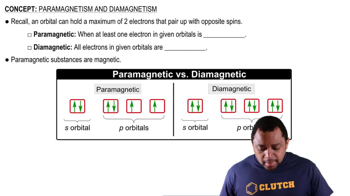
Paramagnetism

Paramagnetism is a property of materials that have unpaired electrons, which causes them to be attracted to magnetic fields. In transition metal complexes, the presence of unpaired electrons in d-orbitals is a key factor in determining whether a complex is paramagnetic. The number of unpaired electrons can be influenced by the metal's oxidation state and the nature of the ligands surrounding it.
Recommended video:
Guided course
01:33
Paramagnetism and Diamagnetism

Crystal Field Theory

Crystal Field Theory (CFT) explains how the arrangement of ligands around a central metal ion affects its electronic structure and properties. According to CFT, the interaction between the metal ion and the ligands leads to the splitting of d-orbitals into different energy levels. The extent of this splitting, influenced by the ligand's strength (strong field vs. weak field), determines the number of unpaired electrons and thus the magnetic properties of the complex.
Recommended video:
Guided course
01:18
The study of ligand-metal interactions helped to form Ligand Field Theory which combines CFT with MO Theory.

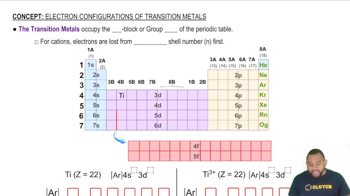
Oxidation States of Transition Metals

The oxidation state of a transition metal in a complex is crucial for determining its electronic configuration and magnetic properties. Different oxidation states can lead to varying numbers of d-electrons, which directly affect the number of unpaired electrons. Understanding the oxidation states of the metals in the given complexes is essential for predicting whether they will exhibit paramagnetism or not.
Recommended video:
Guided course
03:12
Transition Metals
Related Practice
Textbook Question

The amount of paramagnetism for a first-series transition metal complex is related approximately to its spin-only magnetic moment. The spin-only value of the magnetic moment in units of Bohr magnetons (BM) is given by sqrt(n(n + 2)), where n is the number of unpaired electrons. Calculate the spin-only value of the magnetic moment for the 2+ ions of the first-series transition metals (except Sc) in octahedral complexes with (a) weak-field ligands and (b) strong-field ligands. For which electron configurations can the magnetic moment distinguish between high-spin and low-spin electron configurations?

99
views
Textbook Question

Draw a crystal field energy-level diagram, assign the electrons to orbitals, and predict the number of unpaired electrons for each of the following.

(a) [Cu(en)3]2+

(b) [FeF6]2-

(c) [Co(en)3]3+ (low spin) 

93
views
Textbook Question

Draw the structures of all possible diastereoisomers of an octahedral complex with the formula MA2B2C2. Which of the diastereoisomers, if any, can exist as enantiomers?

95
views
Textbook Question

Look at the colors of the isomeric complexes in Figure 21.12, and predict which is the stronger field ligand, nitro (-NO2) of nitrito (-ONO). Explain. 

90
views
Textbook Question

For each of the following complexes, draw a crystal field energy-level diagram, assign the electrons to orbitals, and predict the number of unpaired electrons. 

(a) [CrF6]3-

(b) [V(H2O)6]3+

(c) [Fe(CN)6]3-

96
views
Textbook Question

What is the systematic name for each of the following coordination compounds? 

(c) [Co(NH3)4Br2]Br

(d) Cu(gly)2

170
views