
The reaction A¡products was monitored as a function of time. The results are shown here. Time (s) [A] (M) 0 1.000 25 0.914 50 0.829 75 0.744 100 0.659 125 0.573 150 0.488 175 0.403 200 0.318 Determine the order of the reaction and the value of the rate constant. What is the rate of reaction when [A] = 0.10 M?

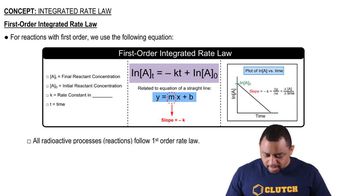
This reaction was monitored as a function of time: A → B + C A plot of ln[A] versus time yields a straight line with slope -0.0105/s. a. What is the value of the rate constant (k) for this reaction at this temperature?
Verified step by step guidanceKey Concepts
First-Order Reactions
Rate Constant (k)
Units of Rate Constant
The half-life for the radioactive decay of U-238 is 4.5 billion years and is independent of initial concentration. If a sample of U-238 initially contained 3.2⨉1018 atoms when the universe was formed 13.8 billion years ago, how many U-238 atoms does it contain today?
The tabulated data show the concentration of AB versus time for this reaction: AB( g)¡A( g) + B( g) Time (s) [AB] (M) 0 0.950 50 0.459 100 0.302 150 0.225 200 0.180 250 0.149 300 0.128 350 0.112 400 0.0994 450 0.0894 500 0.0812 Determine the order of the reaction and the value of the rate constant. Predict the concentration of AB at 25 s.
The half-life for the radioactive decay of C-14 is 5715 years and is independent of the initial concentration. How long does it take for 25.00% of the C-14 atoms in a sample of C-14 to decay?
