
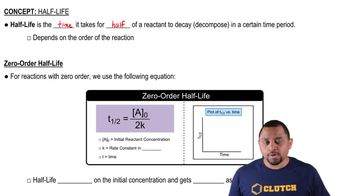
The half-life for the radioactive decay of U-238 is 4.5 billion years and is independent of initial concentration. If a sample of U-238 initially contained 3.2⨉1018 atoms when the universe was formed 13.8 billion years ago, how many U-238 atoms does it contain today?

The half-life for the radioactive decay of C-14 is 5715 years and is independent of the initial concentration. How long does it take for 25.00% of the C-14 atoms in a sample of C-14 to decay?
Verified step by step guidanceKey Concepts
Half-life
Radioactive Decay
Exponential Decay
The diagram shows the energy of a reaction as the reaction progresses. Label each blank box in the diagram.
a. reactants b. products c. activation energy (Ea) d. enthalpy of reaction (ΔHrxn)
The half-life for the radioactive decay of C-14 is 5715 years and is independent of the initial concentration. If a sample of C-14 initially contains 1.5 mmol of C-14, how many millimoles are left after 2725 years?
This reaction was monitored as a function of time: A → B + C A plot of ln[A] versus time yields a straight line with slope -0.0105/s. a. What is the value of the rate constant (k) for this reaction at this temperature?
The activation energy of a reaction is 44.2 kJ/mol and the frequency factor is 1.9⨉1011/ s. Calculate the rate constant of the reaction at 25 °C.
