
Ch.10 - Gases
Brown - Chemistry: The Central Science 14th Edition
Brown14th EditionChemistry: The Central ScienceISBN: 9780134414232Not the one you use?Change textbook
Chapter 10, Problem 59

During a person's typical breathing cycle, the CO2 concentration in the expired air rises to a peak of 4.6% by volume.(a) Calculate the partial pressure of the CO2 in the expiredair at its peak, assuming 1 atm pressure and a body temperature of 37 °C.

Verified step by step guidance
1
Identify the given values: CO2 concentration is 4.6% by volume, total pressure is 1 atm, and temperature is 37 °C.
Recall that partial pressure can be calculated using the formula: \( P_{\text{CO}_2} = \text{mole fraction of CO}_2 \times \text{total pressure} \).
Convert the percentage concentration to a mole fraction: \( \text{mole fraction of CO}_2 = \frac{4.6}{100} \).
Substitute the mole fraction and total pressure into the partial pressure formula: \( P_{\text{CO}_2} = \frac{4.6}{100} \times 1 \text{ atm} \).
Calculate the partial pressure of CO2 using the values from the previous step.

Verified video answer for a similar problem:

This video solution was recommended by our tutors as helpful for the problem above.
Video duration:
1m
Was this helpful?

Key Concepts

Here are the essential concepts you must grasp in order to answer the question correctly.

Partial Pressure

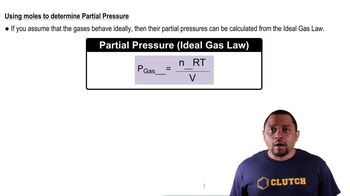
Partial pressure refers to the pressure exerted by a single component of a gas mixture. It can be calculated using Dalton's Law, which states that the total pressure of a gas mixture is equal to the sum of the partial pressures of its individual gases. In this case, the partial pressure of CO2 can be determined by multiplying its volume fraction by the total pressure.
Recommended video:
Guided course
00:48
Partial Pressure Calculation

Gas Laws

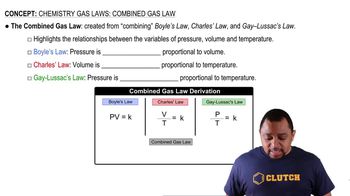
Gas laws describe the behavior of gases under various conditions of temperature and pressure. The Ideal Gas Law (PV=nRT) is particularly relevant here, as it relates pressure (P), volume (V), number of moles (n), the ideal gas constant (R), and temperature (T). Understanding these relationships is crucial for calculating the partial pressure of gases in different scenarios.
Recommended video:
Guided course
01:43
Combined Gas Law

Body Temperature and Gas Behavior

Body temperature, typically around 37 °C (310 K), affects the behavior of gases, including their pressure and volume. At higher temperatures, gas molecules have more kinetic energy, which can influence their pressure when confined in a space. In this question, recognizing the importance of temperature is essential for accurate calculations involving gas behavior in the human body.