

Ch.3 - Chemical Reactions and Reaction Stoichiometry
Brown - Chemistry: The Central Science 14th Edition
Brown14th EditionChemistry: The Central ScienceISBN: 9780134414232Not the one you use?Change textbook
Chapter 3, Problem 106

Boron nitride, BN, is an electrical insulator with remarkable thermal and chemical stability. Its density is 2.1 g/cm3. It can be made by reacting boric acid, H3BO3, with ammonia. The other product of the reaction is water. (b) If you made 225 g of boric acid react with 150 g of ammonia, what mass of BN could you make? (d) One application of BN is as a thin film for electrical insulation. If you take the mass of BN from part (b) and make a 0.4 mm thin film from it, what area, in cm2, would it cover?

Verified step by step guidance
1
Step 1: Write the balanced chemical equation for the reaction between boric acid (H3BO3) and ammonia (NH3) to form boron nitride (BN) and water (H2O).
Step 2: Calculate the molar masses of H3BO3, NH3, and BN using the periodic table to find the atomic masses of each element.
Step 3: Determine the limiting reactant by converting the masses of H3BO3 and NH3 to moles using their respective molar masses, and compare the mole ratio from the balanced equation.
Step 4: Use the moles of the limiting reactant to calculate the theoretical yield of BN in moles, then convert this to grams using the molar mass of BN.
Step 5: To find the area of the BN thin film, use the mass of BN obtained in part (b), the density of BN, and the thickness of the film to calculate the volume, then divide by the thickness to find the area in cm^2.

Key Concepts

Here are the essential concepts you must grasp in order to answer the question correctly.

Stoichiometry

Stoichiometry is the branch of chemistry that deals with the quantitative relationships between reactants and products in a chemical reaction. It allows us to calculate the amounts of substances consumed and produced in a reaction based on balanced chemical equations. Understanding stoichiometry is essential for determining how much boron nitride (BN) can be produced from given amounts of boric acid and ammonia.
Recommended video:
Guided course
01:16
Stoichiometry Concept

Density and Volume Calculations

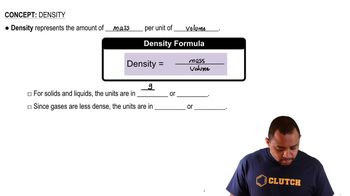
Density is defined as mass per unit volume and is a crucial concept for converting between mass and volume in chemical calculations. In this context, knowing the density of boron nitride (2.1 g/cm³) allows us to calculate the volume of BN produced from its mass. This is important for determining how a specific mass of BN can be formed into a thin film of a given thickness.
Recommended video:
Guided course
01:56
Density Concepts

Area Calculation from Volume

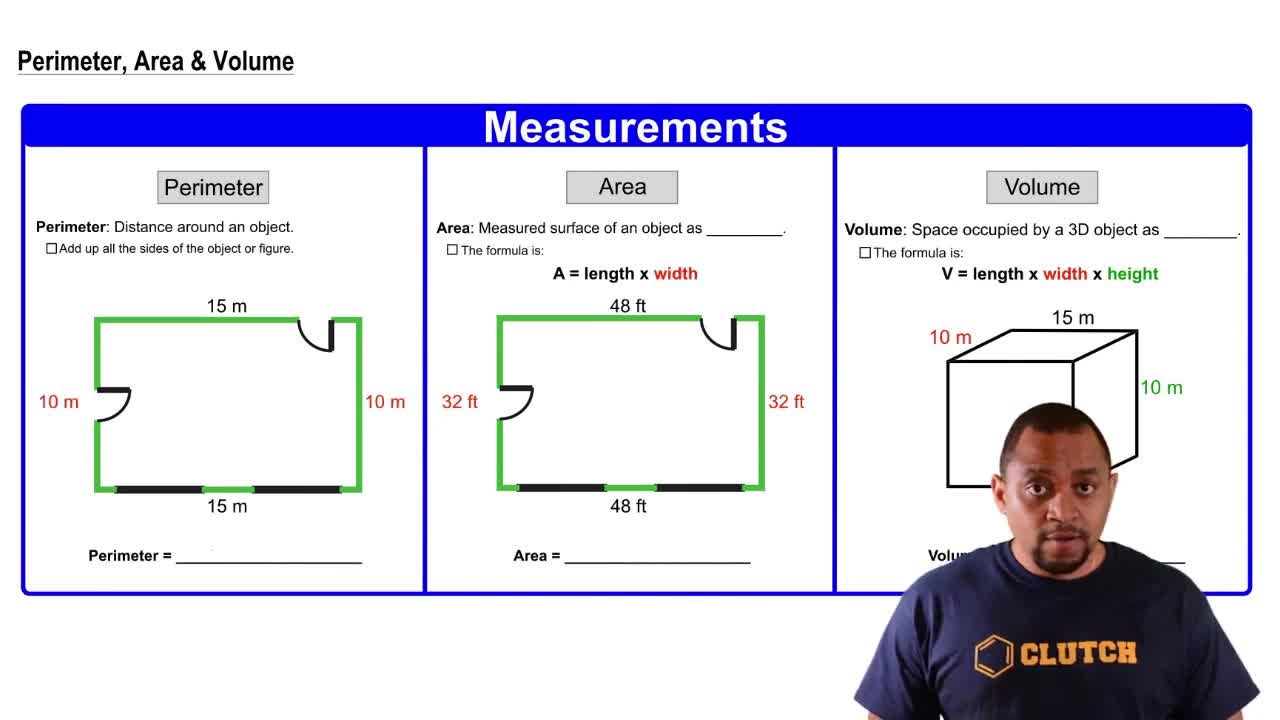
To find the area that a substance will cover when formed into a thin film, we can use the relationship between volume, area, and thickness. The formula is Volume = Area × Thickness. By rearranging this formula, we can calculate the area covered by the boron nitride film using its volume and the specified thickness (0.4 mm). This concept is vital for understanding how the mass of BN translates into a physical area.
Recommended video:
Guided course
03:47
Perimeter, Area, Volume