
A sample of 5.00 mL of diethyl ether (C2H5OC2H5,density=0.7134 g/mL) is introduced into a 6.00-L vessel that already contains a mixture of N2 and O2, whose partial pressures are 𝑃N2=0.751atm and 𝑃O2=0.208atm. The temperature is held at 35.0°C, and the diethyl ether totally evaporates. b. Calculate the total pressure in the container.

A deep-sea diver uses a gas cylinder with a volume of 10.0 L and a content of 51.2 g of O2 and 32.6 g of He. Calculate the partial pressure of each gas and the total pressure if the temperature of the gas is 19 °C.
Verified step by step guidanceKey Concepts
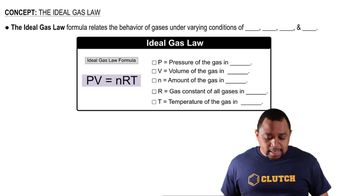
Ideal Gas Law
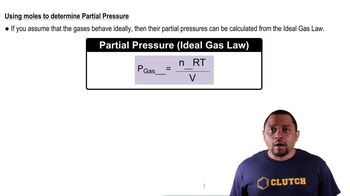
Partial Pressure
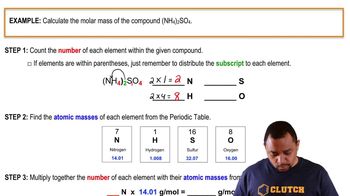
Molar Mass and Moles Calculation
Consider the apparatus shown in the following drawing. (a) When the valve between the two containers is opened and the gases are allowed to mix, how does the volume occupied by the N2 gas change?
Consider a mixture of two gases, A and B, confined in a closed vessel. A quantity of a third gas, C, is added to the same vessel at the same temperature. How does the addition of gas C affect the following: (a) the partial pressure of gas A?
The atmospheric concentration of CO2 gas is presently 407 ppm (parts per million, by volume; that is, 407 L of every 106 L of the atmosphere are CO2). What is the mole fraction of CO2 in the atmosphere?.
A piece of dry ice (solid carbon dioxide) with a mass of 5.50 g is placed in a 10.0-L vessel that already contains air at 705 torr and 24°C. After the carbon dioxide has totally sublimed, what is the partial pressure of the resultant CO2 gas, and the total pressure in the container, at 24°C?
