Ch.19 - Electrochemistry
McMurry - Chemistry 8th Edition
McMurry8th EditionChemistryISBN: 9781292336145Not the one you use?Change textbook
Chapter 19, Problem 104

Standard reduction potentials for the Pb2+/Pb and Cd2+/Cd half-reactions are -0.13 V and -0.40 V, respectively. At what relative concentrations of Pb2+ and Cd2+ will these half-reactions have the same reduction potential?

Verified step by step guidance
1
Step 1: Understand that the problem involves finding the relative concentrations of Pb2+ and Cd2+ where their reduction potentials are equal. This involves using the Nernst equation, which relates the reduction potential of a half-cell to the standard reduction potential and the concentrations of the involved species.
Step 2: Write the Nernst equation for each half-reaction. For the Pb2+/Pb half-reaction, the equation is: E = E° - (RT/nF) * ln([Pb]/[Pb2+]). For the Cd2+/Cd half-reaction, the equation is: E = E° - (RT/nF) * ln([Cd]/[Cd2+]).
Step 3: Set the two Nernst equations equal to each other since we want the reduction potentials to be the same: E°(Pb) - (RT/nF) * ln([Pb]/[Pb2+]) = E°(Cd) - (RT/nF) * ln([Cd]/[Cd2+]).
Step 4: Substitute the given standard reduction potentials into the equation: -0.13 V - (RT/nF) * ln([Pb]/[Pb2+]) = -0.40 V - (RT/nF) * ln([Cd]/[Cd2+]).
Step 5: Solve the equation for the ratio of concentrations [Pb2+]/[Cd2+]. This involves algebraic manipulation to isolate the concentration terms and solve for the desired ratio.

Key Concepts

Here are the essential concepts you must grasp in order to answer the question correctly.

Standard Reduction Potential

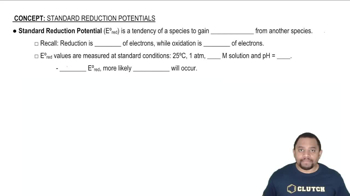
Standard reduction potential (E°) is a measure of the tendency of a chemical species to gain electrons and be reduced. It is measured in volts and is determined under standard conditions (1 M concentration, 1 atm pressure, and 25°C). A higher E° value indicates a greater likelihood of reduction. In this question, the E° values for Pb2+/Pb and Cd2+/Cd are crucial for determining the conditions under which their reduction potentials are equal.
Recommended video:
Guided course
01:10
Standard Reduction Potentials

Nernst Equation

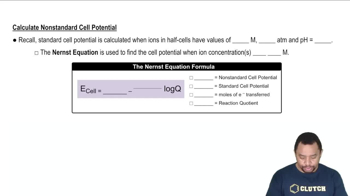
The Nernst equation relates the reduction potential of a half-reaction to the concentrations of the reactants and products involved. It is expressed as E = E° - (RT/nF) ln(Q), where Q is the reaction quotient. This equation allows us to calculate the potential under non-standard conditions, which is essential for finding the relative concentrations of Pb2+ and Cd2+ that equalize their potentials.
Recommended video:
Guided course
01:17
The Nernst Equation

Reaction Quotient (Q)

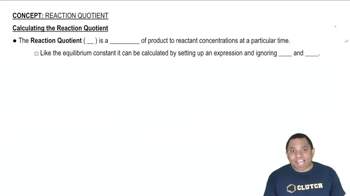
The reaction quotient (Q) is a ratio that expresses the relative concentrations of products to reactants at any point in a reaction. For the half-reactions in question, Q can be defined as [Pb2+]/[Cd2+]. When the concentrations of Pb2+ and Cd2+ are adjusted, Q will change, affecting the overall cell potential. Setting the potentials equal allows us to solve for the specific concentrations needed for equilibrium.
Recommended video:
Guided course
00:49
Reaction Quotient Q
Related Practice