Ch.19 - Electrochemistry
McMurry - Chemistry 8th Edition
McMurry8th EditionChemistryISBN: 9781292336145Not the one you use?Change textbook
Chapter 19, Problem 102

What is the reduction potential at 25 °C for the hydrogen electrode in each of the following solutions? The half-reaction is . (c) Pure water.

Verified step by step guidance
1
Identify the half-reaction for the hydrogen electrode, which is typically represented as: \( \text{H}_2(g) + 2\text{e}^- \rightarrow 2\text{H}^+(aq) \).
Understand that the standard reduction potential for the hydrogen electrode is defined as 0 V under standard conditions, which include 1 M concentration of \( \text{H}^+ \) ions.
Recognize that in pure water, the concentration of \( \text{H}^+ \) ions is determined by the autoionization of water, where \( [\text{H}^+] = 10^{-7} \text{M} \) at 25 °C.
Apply the Nernst equation to calculate the reduction potential under non-standard conditions: \( E = E^0 - \frac{RT}{nF} \ln Q \), where \( E^0 \) is the standard reduction potential, \( R \) is the gas constant, \( T \) is the temperature in Kelvin, \( n \) is the number of moles of electrons transferred, \( F \) is Faraday's constant, and \( Q \) is the reaction quotient.
Substitute the known values into the Nernst equation: \( E = 0 - \frac{8.314 \times 298}{2 \times 96485} \ln \left( \frac{1}{[\text{H}^+]^2} \right) \), where \( [\text{H}^+] = 10^{-7} \text{M} \).

Key Concepts

Here are the essential concepts you must grasp in order to answer the question correctly.

Reduction Potential

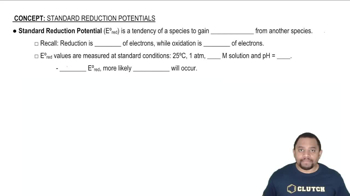
Reduction potential is a measure of the tendency of a chemical species to acquire electrons and thereby be reduced. It is expressed in volts and is determined under standard conditions, typically at 25 °C and 1 M concentration. A higher reduction potential indicates a greater likelihood of reduction occurring, making it a crucial concept in electrochemistry.
Recommended video:
Guided course
01:10
Standard Reduction Potentials

Standard Hydrogen Electrode (SHE)

The Standard Hydrogen Electrode (SHE) is a reference electrode used to measure the reduction potentials of other half-reactions. It is defined as having a potential of 0.00 V at all temperatures and is based on the half-reaction of hydrogen ions gaining electrons to form hydrogen gas. The SHE serves as a baseline for comparing the reactivity of other electrodes.

pH and its Effect on Reduction Potential

The pH of a solution significantly influences the reduction potential of the hydrogen electrode. In pure water, the pH is approximately 7, which affects the concentration of hydrogen ions (H+) in the solution. Since the reduction potential is dependent on the concentration of H+, changes in pH can shift the potential, making it essential to consider when calculating the reduction potential in different solutions.
Recommended video:
Guided course
01:10
Standard Reduction Potentials