Ch.2 - Atoms, Molecules & Ions
McMurry - Chemistry 8th Edition
McMurry8th EditionChemistryISBN: 9781292336145Not the one you use?Change textbook
Chapter 2, Problem 85

In addition to carbon monoxide (CO) and carbon dioxide (CO2), there is a third compound of carbon and oxygen called carbon suboxide. If a 2.500 g sample of carbon suboxide contains 1.32 g of C and 1.18 g of O, show that the law of multiple proportions is followed. What is a possible formula for carbon suboxide?

Verified step by step guidance
1
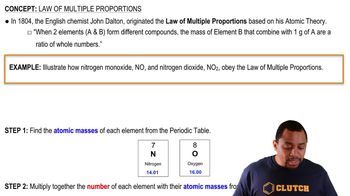
Step 1: Understand the law of multiple proportions, which states that if two elements form more than one compound, the masses of one element that combine with a fixed mass of the other are in the ratio of small whole numbers.
Step 2: Calculate the mass ratio of carbon to oxygen in carbon suboxide by dividing the mass of carbon (1.32 g) by the mass of oxygen (1.18 g).
Step 3: Compare the mass ratio of carbon to oxygen in carbon suboxide with the known mass ratios in carbon monoxide (CO) and carbon dioxide (CO2). For CO, the ratio is 12:16, and for CO2, it is 12:32.
Step 4: Determine if the mass ratio from carbon suboxide can be expressed as a small whole number ratio when compared to the ratios in CO and CO2, thus confirming the law of multiple proportions.
Step 5: Propose a possible formula for carbon suboxide by using the calculated mass ratio and ensuring it aligns with the small whole number ratio requirement.

Key Concepts

Here are the essential concepts you must grasp in order to answer the question correctly.

Law of Multiple Proportions

The Law of Multiple Proportions states that when two elements form more than one compound, the ratios of the masses of one element that combine with a fixed mass of the other element can be expressed as small whole numbers. This principle helps to demonstrate that compounds can have different compositions while still being made of the same elements.
Recommended video:
Guided course
03:32
Law of Multiple Proportions

Mass Composition of Compounds

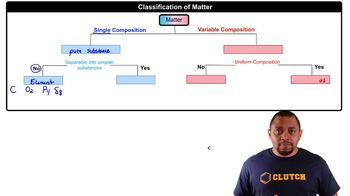
Understanding the mass composition of compounds involves calculating the mass percentages of each element within a compound. In this case, knowing the masses of carbon and oxygen in carbon suboxide allows for the determination of their ratios, which is essential for applying the Law of Multiple Proportions.
Recommended video:
Guided course
04:19
Matter Composition

Empirical and Molecular Formulas

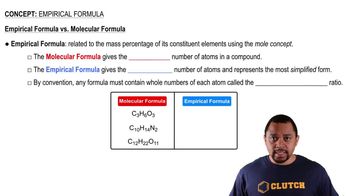
An empirical formula represents the simplest whole-number ratio of elements in a compound, while a molecular formula shows the actual number of atoms of each element in a molecule. By analyzing the mass data of carbon and oxygen in carbon suboxide, one can derive a possible empirical formula, which can then be used to suggest a molecular formula.
Recommended video:
Guided course
02:26
Empirical vs Molecular Formula
Related Practice
Textbook Question
The atomic weight of carbon (12.011) is approximately 12 times that of hydrogen (1.008).(a) Show how you can use this knowledge to calculate pos-sible formulas for benzene, ethane, and ethylene (Prob-lem 2.82).
1164
views
1
rank

Textbook Question
Which of the following charges is not possible for the over-all charge on an oil droplet in Millikan's experiment? For this problem, we'll round the currently accepted charge of an electron to 1.602 * 10-19 C.(a) -1.010 * 10-18 C (b) -8.010 * 10-19 C(c) -2.403 * 10-18 C
820
views
Textbook Question

Label the following statements about J. J. Thomson's cathode-ray tube experiments shown in Figure 2.6 as true or false. (f) By measuring the deflection of the cathode ray beam caused by electric fields of known strength, the charge-to-mass ratio of the electron was calculated.

408
views
Textbook Question

Label the following statements about J. J. Thomson's cathode-ray tube experiments shown in Figure 2.6 as true or false. (c) The cathode ray is deflected away from a positively charged plate.

476
views
1
rank
Textbook Question
Benzene, ethane, and ethylene are just three of a large num-ber of hydrocarbons—compounds that contain only carbon and hydrogen. Show how the following data are consistent with the law of multiple proportions.
529
views
Textbook Question
In borane, one part hydrogen combines with 3.6 parts boron by mass. A compound containing only hydrogen and boron contains 6.0 g of hydrogen and 43.2 g of boron. Could this compound be borane? If it is not borane, show that the law of multiple proportions is followed for borane and this other substance.
693
views