Predict the crystal field energy-level diagram for a linear ML2 complex that has two ligands along the :
Ch.21 - Transition Elements and Coordination Chemistry
Chapter 21, Problem 21.94
Draw the structure of all isomers of the octahedral complex [NbX2Cl4]- (X- = NCS-), and identify those that are linkage isomers.
Verified step by step guidance1
Identify the coordination number and geometry of the complex. The complex [NbX_2Cl_4]^- has a coordination number of 6, which corresponds to an octahedral geometry.
Determine the possible positions for the ligands in the octahedral complex. In an octahedral complex, there are six positions around the central metal ion.
Consider the different ways to arrange the ligands. For [NbX_2Cl_4]^-, you can have the X ligands (NCS^-) and Cl ligands in different positions, leading to different isomers.
Draw the possible geometric isomers. In an octahedral complex, you can have cis and trans isomers depending on the relative positions of the same ligands.
Identify linkage isomers. Linkage isomers occur when a ligand can bind through different atoms. For NCS^-, it can bind through N (nitrogen) or S (sulfur), leading to different linkage isomers.

Verified video answer for a similar problem:
This video solution was recommended by our tutors as helpful for the problem above.
Was this helpful?
Key Concepts
Here are the essential concepts you must grasp in order to answer the question correctly.
Octahedral Complexes
Octahedral complexes are coordination compounds where a central metal atom is surrounded by six ligands arranged at the corners of an octahedron. The geometry and spatial arrangement of these ligands can lead to different isomers, including geometric and optical isomers, which are crucial for understanding the properties and reactivity of the complex.
Recommended video:
Guided course
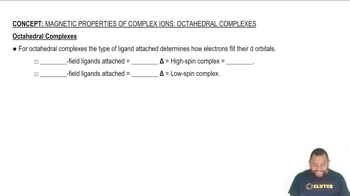
For octahedral complexes, Weak-Field Ligands create High-spin complexes and Strong-Field Ligands create Low-spin complexes.
Isomerism in Coordination Compounds
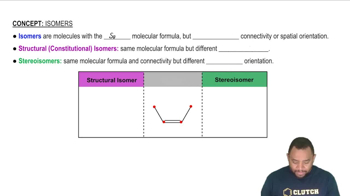
Isomerism in coordination compounds refers to the existence of compounds with the same formula but different arrangements of atoms or ligands. In octahedral complexes, isomers can be classified into structural isomers, such as linkage isomers, where ligands can bind to the metal in different ways, affecting the compound's properties and reactivity.
Recommended video:
Guided course
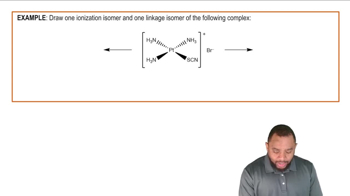
Isomerism in Coordination Complexes Example
Linkage Isomers
Linkage isomers occur when a ligand can coordinate to the metal center through different atoms. For example, in the case of the thiocyanate ion (NCS-), it can bind through the nitrogen or the sulfur atom, leading to distinct isomers. Identifying these isomers is essential for understanding the chemical behavior and potential applications of the complex.
Recommended video:
Guided course
Isomers
Related Practice
Textbook Question
108
views
Textbook Question
What is the name of the compound [Fe(H2O)5(SCN)]Cl2?
(a) pentaaquathiocyanatoiron(III) chloride
(b) pentaaquachlorothiocyanato iron(III)
(c) pentaaquathiocyanatoiron(III) dichloride
(d) pentaaquathiocyanatoiron(II) chloride
494
views
Textbook Question
Draw the structures of all possible diastereoisomers of an octahedral complex with the formula MA2B2C2. Which of the diastereoisomers, if any, can exist as enantiomers?
95
views
Textbook Question
Predict the number of unpaired electrons for each of the following.
(a) Sc3+
(b) Co2+
83
views
Textbook Question
Which of the following complexes are diamagnetic?
(a) [Ni(H2O)6]2+
(b) [Co(CN)6]3-
(c) [HgI4]2- (tetrahedral)
(d) [Cu(NH3)4]2+ (square planar)
122
views
Textbook Question
Classify the following ligands as monodentate, bidentate, tri-dentate, or tetradentate. Which can form chelate rings?
(a)
(b)
(c)
(d)
108
views