
Ch.21 - Transition Elements and Coordination Chemistry
McMurry - Chemistry 8th Edition
McMurry8th EditionChemistryISBN: 9781292336145Not the one you use?Change textbook
Chapter 21, Problem 21.93

What is a racemic mixture? Does it affect plane-polarized light? Explain.

Verified step by step guidance
1
A racemic mixture is a 50:50 mixture of two enantiomers, which are molecules that are mirror images of each other and cannot be superimposed.
Enantiomers have the ability to rotate plane-polarized light, but they do so in opposite directions. One enantiomer will rotate light in a clockwise direction (dextrorotatory), while the other will rotate it counterclockwise (levorotatory).
In a racemic mixture, the effects of the two enantiomers on plane-polarized light cancel each other out because they are present in equal amounts.
As a result, a racemic mixture does not rotate plane-polarized light and is considered optically inactive.
This property is important in chemistry and pharmacology, as the biological activity of enantiomers can differ significantly, even though they have the same chemical composition.

Verified video answer for a similar problem:

This video solution was recommended by our tutors as helpful for the problem above.
Was this helpful?

Key Concepts

Here are the essential concepts you must grasp in order to answer the question correctly.

Racemic Mixture

A racemic mixture is a combination of equal amounts of two enantiomers, which are molecules that are mirror images of each other. These enantiomers have identical physical properties except for their interaction with plane-polarized light. In a racemic mixture, the optical activities of the two enantiomers cancel each other out, resulting in no net rotation of plane-polarized light.

Enantiomers

Enantiomers are a type of stereoisomer that are non-superimposable mirror images of each other. They possess the same molecular formula and connectivity but differ in the spatial arrangement of atoms. This difference can lead to distinct chemical behaviors, particularly in biological systems, where one enantiomer may be more active or effective than the other.
Recommended video:
Guided course
02:33
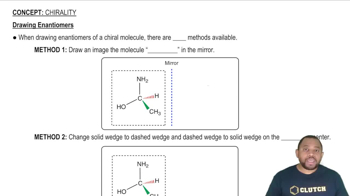
Drawing Enantiomers

Optical Activity

Optical activity refers to the ability of a substance to rotate the plane of polarized light. This property is a characteristic of chiral compounds, which include enantiomers. When plane-polarized light passes through a solution of a chiral substance, it can be rotated to the right (dextrorotatory) or to the left (levorotatory), depending on the specific enantiomer present. In racemic mixtures, the opposing rotations of the enantiomers result in no overall optical activity.
Recommended video:
Guided course
02:02
Activity Series Chart
Related Practice
Textbook Question

The amount of paramagnetism for a first-series transition metal complex is related approximately to its spin-only magnetic moment. The spin-only value of the magnetic moment in units of Bohr magnetons (BM) is given by sqrt(n(n + 2)), where n is the number of unpaired electrons. Calculate the spin-only value of the magnetic moment for the 2+ ions of the first-series transition metals (except Sc) in octahedral complexes with (a) weak-field ligands and (b) strong-field ligands. For which electron configurations can the magnetic moment distinguish between high-spin and low-spin electron configurations?

99
views
Textbook Question

The oxalate ion is a bidentate ligand as indicated in Figure 21.8. Would you expect the carbonate ion to be a monodentate or bidentate ligand? Explain your reasoning.

108
views
Textbook Question

Look at the colors of the isomeric complexes in Figure 21.12, and predict which is the stronger field ligand, nitro (-NO2) of nitrito (-ONO). Explain. 

89
views
Textbook Question

Which of the following complexes are paramagnetic?

(a) [Mn(CN)6]3-

(b) [Zn(NH3)4]2+ (tetrahedral)

(c) [Fe(CN)6]4-

(d) [FeF6]4-

101
views
Textbook Question

Based on the wavelength of maximum absorption of the cobalt complexes, arrange the following ligands in a spectrochemical series from weakest-field to strongest-field ligand. 

(a) Cl- < NCS- < H2O < NH3 

(b) Cl- < NCS- < H2O < NH3 

(c) H2O < Cl- < NH3 < NCS-

(d) Cl- < H2O < NCS- < NH3

105
views
Textbook Question

What hybrid orbitals are used by the metal ion and how many unpaired electrons are present the complex ion [VCl4]- with tetrahedral geometry?

(a) sp3; 2 unpaired electrons

(b) sp3; 3 unpaired electrons

(c) sp3d2; 3 unpaired electrons

(d) sp3d2; 4 unpaired electrons

88
views