The [Cr(H2O)6]3+ ion is violet, and [Cr(CN)6]3- is yellow. Explain this difference using crystal field theory. Use the colors to order H2O and CN- in the spectrochemical series.
Ch.21 - Transition Elements and Coordination Chemistry
Chapter 21, Problem 21.64
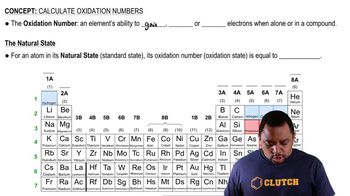
What is the oxidation state of the metal in each of the complexes?
a. AgCl2–
b. [Cr(H2O)5Cl]2+
c. [Co(NCS)4]2–
d. [ZrF8]4–
e. [Fe(EDTA)(H2O)]–
Verified step by step guidance1
Step 1: Understand the concept of oxidation state. The oxidation state is the charge of an atom if all bonds were ionic. It helps in determining the electron count of the metal in a complex.
Step 2: For each complex, identify the charge of the ligands and the overall charge of the complex. This will help in determining the oxidation state of the metal.
Step 3: For complex a, AgCl2–: Chloride (Cl–) has a charge of -1. With two chlorides, the total charge from ligands is -2. The overall charge of the complex is -1. Use the equation: oxidation state of Ag + (-2) = -1.
Step 4: For complex b, [Cr(H2O)5Cl]2+: Water (H2O) is neutral, and chloride (Cl–) has a charge of -1. The overall charge of the complex is +2. Use the equation: oxidation state of Cr + (-1) = +2.
Step 5: Repeat similar calculations for the remaining complexes: c. [Co(NCS)4]2–, d. [ZrF8]4–, and e. [Fe(EDTA)(H2O)]–, considering the charges of NCS–, F–, and EDTA4– respectively.

Verified video answer for a similar problem:
This video solution was recommended by our tutors as helpful for the problem above.
Was this helpful?
Key Concepts
Here are the essential concepts you must grasp in order to answer the question correctly.
Oxidation State
The oxidation state, or oxidation number, is a measure of the degree of oxidation of an atom in a chemical compound. It indicates the number of electrons that an atom can gain, lose, or share when forming chemical bonds. Understanding oxidation states is crucial for determining the charge of metal ions in coordination complexes and helps in balancing redox reactions.
Recommended video:
Guided course
Oxidation Numbers
Coordination Complexes
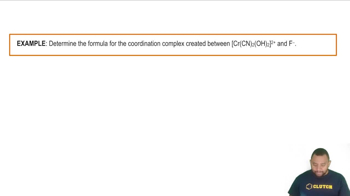
Coordination complexes consist of a central metal atom or ion bonded to surrounding molecules or ions, known as ligands. The nature of these ligands and their arrangement around the metal can influence the oxidation state of the metal. Analyzing the overall charge of the complex and the charges of the ligands is essential for calculating the oxidation state of the metal.
Recommended video:
Guided course
Coordination Complexes Example
Charge Balance
Charge balance is the principle that the total positive charge in a compound must equal the total negative charge. In coordination complexes, this involves summing the oxidation states of the metal and the charges of the ligands to ensure that the overall charge of the complex matches the given charge. This concept is fundamental for determining the oxidation state of the metal in various complexes.
Recommended video:
Guided course
Formal Charge
Related Practice
Textbook Question
137
views
Textbook Question
The glycinate anion, gly-= NH2CH2CO2 -, bonds to metal ions through the N atom and one of the O atoms. Using to represent gly-, sketch the structures of the four stereoisomers of Co(gly)3.
134
views
Textbook Question
What is the oxidation state of the metal in each of the complexes?
a. [Ni(CN)5]3–
b. Ni(CO)4
c. [Co(en)2(H2O)Br]2+
d. [Cu(H2O)2(C2O4)2]2–
e. Co(NH3)3(NO2)3
72
views
Textbook Question
What role does EDTA4- play as a trace additive to mayonnaise? Would the glycinate ion (H2NCH2CH2NH2) be an effective substitute for EDTA4-?
71
views
Textbook Question
Which of the following complexes can exist as enantiomers? Draw their structures.
(a) [Cr(en)3]3+
(b) cis-[Co(NH3)Cl]2+
(c) trans-[Co(en)2(NH3)Cl]2+
(d) [Pt(NH3)3Cl3]+
112
views
Textbook Question
Predict the number of unpaired electrons for each of the following.
(a) Sc3+
(b) Co2+
83
views