a. Why is the SO3 molecule trigonal planar but the SO32– ion is trigonal pyramidal?
Ch.22 - The Main Group Elements
Chapter 22, Problem 22.29a
Consider the six second- and third-row elements in groups 4A–6A of the periodic table:
Possible structures for the binary fluorides of each of these elements in its highest oxidation state are shown below.
(a) Identify the nonfluorine atom in each case, and write the molecular formula of each fluoride.
Verified step by step guidance1
Identify the elements in groups 4A–6A of the periodic table from the second and third rows.
List the elements: Carbon (C), Silicon (Si), Germanium (Ge), Tin (Sn), Lead (Pb) for group 4A; Nitrogen (N), Phosphorus (P), Arsenic (As), Antimony (Sb), Bismuth (Bi) for group 5A; Oxygen (O), Sulfur (S), Selenium (Se), Tellurium (Te), Polonium (Po) for group 6A.
Determine the highest oxidation state for each element, which is equal to the group number.
Write the molecular formula for the binary fluorides by combining each element with fluorine (F) in its highest oxidation state.
For example, for Carbon in group 4A, the highest oxidation state is +4, so the formula is CF4. Repeat this for each element.

Verified video answer for a similar problem:
This video solution was recommended by our tutors as helpful for the problem above.
Was this helpful?
Key Concepts
Here are the essential concepts you must grasp in order to answer the question correctly.
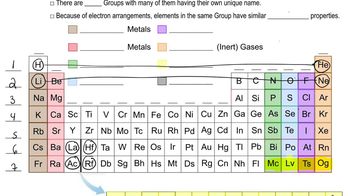
Periodic Table Groups
The periodic table is organized into groups (columns) that share similar chemical properties. Groups 4A to 6A include elements such as carbon, silicon, germanium, tin, lead, and their corresponding nonmetals. Understanding the position of these elements helps predict their behavior and the types of compounds they form, including binary fluorides.
Recommended video:
Guided course
Periodic Table: Group Names
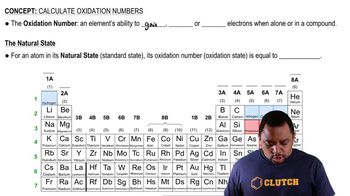
Oxidation States
Oxidation states indicate the degree of oxidation of an atom in a compound, reflecting the number of electrons lost or gained. In the context of binary fluorides, the highest oxidation state of an element determines how many fluorine atoms can bond with it. This is crucial for writing the correct molecular formulas for the fluorides of the specified elements.
Recommended video:
Guided course
Oxidation Numbers
Binary Compounds
Binary compounds consist of two different elements. In this case, the binary fluorides are formed by combining the nonfluorine atom from groups 4A to 6A with fluorine. Identifying the nonfluorine atom and understanding how it interacts with fluorine is essential for determining the correct molecular formulas for these compounds.
Recommended video:
Guided course
Binary Acids
Related Practice
Textbook Question
109
views
Textbook Question
Write a balanced net ionic equation for the reaction of the amphoteric oxide Ga2O3 with:
a. Aqueous sulfuric acid
73
views
Textbook Question
Which compound in each of the following pairs is more covalent?
(a) PCl3 or AlF3
109
views
Textbook Question
Write a balanced net ionic equation for the reaction of the amphoteric oxide ZnO with:
a. Hydrochloric acid
84
views
Textbook Question
Which element in each of the following pairs has more nonmetallic character?
(a) Se or Te
86
views
Textbook Question
In the following pictures of binary hydrides, ivory spheres
represent H atoms or ions, and burgundy spheres represent
atoms or ions of the other element.
(1)
(2)
(3)
(4)
(a) Identify each binary hydride as ionic, covalent, or interstitial.
(b) What is the oxidation state of hydrogen in compounds (1), (2), and (3)? What is the oxidation state of the other
element?
91
views