
Nitrogen has a normal boiling point of 77.3 K and a melting point (at 1 atm) of 63.1 K. Its critical temperature is 126.2 K and its critical pressure is 2.55×10⁴ torr. It has a triple point at 63.1 K and 94.0 torr. Sketch the phase diagram for nitrogen. Does nitrogen have a stable liquid state at 1 atm?
Ch.12 - Liquids, Solids & Intermolecular Forces

Chapter 12, Problem 75
A 10.5-g ice cube at 0°C is placed into 245-g of water. Calculate the temperature change in the water upon the complete melting of the ice. Assume that all of the energy required to melt the ice comes from the water.
Verified step by step guidance1
Identify the heat required to melt the ice using the formula: \( q = m \times \Delta H_f \), where \( m \) is the mass of the ice and \( \Delta H_f \) is the heat of fusion for ice.
Calculate the heat \( q \) needed to melt the 10.5-g ice cube using the heat of fusion for ice, which is 334 J/g.
Determine the heat lost by the water using the formula: \( q = m \times c \times \Delta T \), where \( m \) is the mass of the water, \( c \) is the specific heat capacity of water (4.18 J/g°C), and \( \Delta T \) is the change in temperature.
Set the heat lost by the water equal to the heat gained by the ice: \( m_{\text{ice}} \times \Delta H_f = m_{\text{water}} \times c \times \Delta T \).
Solve for \( \Delta T \), the change in temperature of the water, by rearranging the equation: \( \Delta T = \frac{m_{\text{ice}} \times \Delta H_f}{m_{\text{water}} \times c} \).

Verified video answer for a similar problem:
This video solution was recommended by our tutors as helpful for the problem above.
Video duration:
8mWas this helpful?
Key Concepts
Here are the essential concepts you must grasp in order to answer the question correctly.
Heat Transfer
Heat transfer is the process by which thermal energy moves from one object to another due to a temperature difference. In this scenario, the warmer water transfers heat to the colder ice cube, causing the ice to melt. Understanding this concept is crucial for calculating the temperature change in the water as it loses energy.
Recommended video:
Guided course
Heat Capacity
Latent Heat of Fusion
The latent heat of fusion is the amount of energy required to change a substance from solid to liquid at its melting point without changing its temperature. For ice, this value is approximately 334 J/g. This concept is essential for determining how much energy the water must provide to completely melt the 10.5-g ice cube.
Recommended video:
Guided course
Heat Capacity
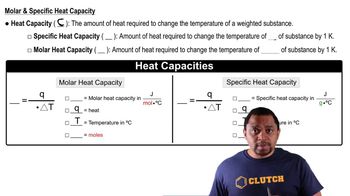
Specific Heat Capacity
Specific heat capacity is the amount of heat required to raise the temperature of a unit mass of a substance by one degree Celsius. For water, this value is about 4.18 J/g°C. This concept is important for calculating the resulting temperature change in the water after it has lost energy to melt the ice.
Recommended video:
Guided course
Heat Capacity
Related Practice
Textbook Question
2550
views
Textbook Question
Consider the phase diagram shown here. Identify the states present at points a through g.
1221
views
Textbook Question
Carbon disulfide has a vapor pressure of 363 torr at 25 °C and a normal boiling point of 46.3 °C. Find ΔHvap for carbon disulfide.
2567
views
Textbook Question
Calculate the amount of heat required to completely sublime 75.0 g of solid dry ice (CO2) at its sublimation temperature. The heat of sublimation for carbon dioxide is 32.3 kJ/mol.
Textbook Question
How much ice (in grams) would have to melt to absorb 155 kJ of energy?
Textbook Question
How much energy is released when 75.2 g of water freezes?
