Benzene has a heat of vaporization of 30.72 kJ/mol and a normal boiling point of 80.1 °C. At what temperature does benzene boil when the external pressure is 445 torr?
Ch.12 - Liquids, Solids & Intermolecular Forces

Chapter 12, Problem 71
Carbon disulfide has a vapor pressure of 363 torr at 25 °C and a normal boiling point of 46.3 °C. Find ΔHvap for carbon disulfide.
Verified step by step guidance1
Identify the Clausius-Clapeyron equation: \( \ln \left( \frac{P_2}{P_1} \right) = -\frac{\Delta H_{\text{vap}}}{R} \left( \frac{1}{T_2} - \frac{1}{T_1} \right) \), where \( P_1 \) and \( P_2 \) are the vapor pressures at temperatures \( T_1 \) and \( T_2 \), respectively, and \( R \) is the ideal gas constant.
Recognize that the normal boiling point is the temperature at which the vapor pressure equals 1 atm (760 torr). Thus, \( P_2 = 760 \text{ torr} \) and \( T_2 = 46.3 \degree C \) (convert to Kelvin by adding 273.15).
Use the given vapor pressure at 25 °C: \( P_1 = 363 \text{ torr} \) and \( T_1 = 25 \degree C \) (convert to Kelvin by adding 273.15).
Substitute the known values into the Clausius-Clapeyron equation to solve for \( \Delta H_{\text{vap}} \).
Rearrange the equation to isolate \( \Delta H_{\text{vap}} \): \( \Delta H_{\text{vap}} = -R \cdot \frac{\ln \left( \frac{P_2}{P_1} \right)}{\left( \frac{1}{T_2} - \frac{1}{T_1} \right)} \).

Verified video answer for a similar problem:
This video solution was recommended by our tutors as helpful for the problem above.
Was this helpful?
Key Concepts
Here are the essential concepts you must grasp in order to answer the question correctly.
Vapor Pressure
Vapor pressure is the pressure exerted by a vapor in equilibrium with its liquid or solid phase at a given temperature. It reflects the tendency of particles to escape from the liquid phase into the vapor phase. A higher vapor pressure indicates a greater volatility of the substance, which is crucial for understanding phase changes and calculating thermodynamic properties like enthalpy of vaporization.
Recommended video:
Guided course
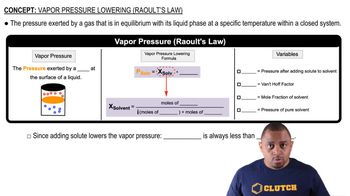
Raoult's Law and Vapor Pressure
Enthalpy of Vaporization (ΔH<sub>vap</sub>)
The enthalpy of vaporization (ΔH<sub>vap</sub>) is the amount of energy required to convert a unit quantity of a liquid into vapor at constant temperature and pressure. It is a critical parameter in thermodynamics that helps quantify the energy changes associated with phase transitions. This value can be determined using the Clausius-Clapeyron equation, which relates vapor pressure and temperature to ΔH<sub>vap</sub>.
Recommended video:
Guided course
Enthalpy of Vaporization Example
Clausius-Clapeyron Equation
The Clausius-Clapeyron equation describes the relationship between the vapor pressure of a substance and its temperature, allowing for the calculation of the enthalpy of vaporization. It is expressed as d(ln P)/dT = ΔH<sub>vap</sub>/(RT²), where P is the vapor pressure, T is the temperature, R is the ideal gas constant, and ΔH<sub>vap</sub> is the enthalpy of vaporization. This equation is essential for solving problems involving phase changes and thermodynamic properties.
Recommended video:
Guided course
Clausius-Clapeyron Equation
Related Practice
Textbook Question
1978
views
Textbook Question
A 10.5-g ice cube at 0°C is placed into 245-g of water. Calculate the temperature change in the water upon the complete melting of the ice. Assume that all of the energy required to melt the ice comes from the water.
Textbook Question
Calculate the amount of heat required to completely sublime 75.0 g of solid dry ice (CO2) at its sublimation temperature. The heat of sublimation for carbon dioxide is 32.3 kJ/mol.
Textbook Question
How much energy is released when 75.2 g of water freezes?
Textbook Question
Ethanol has a heat of vaporization of 38.56 kJ/mol and a normal boiling point of 78.4 °C. What is the vapor pressure of ethanol at 15 °C?
5630
views
1
comments