Anthropologists can estimate the age of a bone or other sample of organic matter by its carbon-14 content. The carbon-14 in a living organism is constant until the organism dies, after which carbon- 14 decays with first-order kinetics and a half-life of 5730 years. Suppose a bone from an ancient human contains 19.5% of the C-14 found in living organisms. How old is the bone?

What rate law corresponds to the proposed mechanism for the formation of hydrogen iodide, which can be written in simplified form as: I2 Δk1k-1 2I (Fast), I + H2 Δk2k-2 H2I (Fast), H2I + I ¡k3 2HI (Slow)?
Verified step by step guidanceKey Concepts
Rate Law
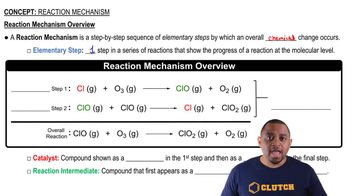
Reaction Mechanism
Elementary Steps and Rate-Determining Step
Consider the gas-phase reaction: H2(g) + I2(g) → 2 HI(g) The reaction was experimentally determined to be first order in H2 and first order in I2. Consider the proposed mechanisms. Proposed mechanism I: H2(g) + I2(g) → 2 HI(g) Single step Proposed mechanism II: I2(g) Δk1k-12 I(g) Fast H2( g) + 2 I( g) → k22 HI( g) Slow b. What kind of experimental evidence might lead you to favor mechanism II over mechanism I?
The half-life for radioactive decay (a first-order process) of plutonium- 239 is 24,000 years. How many years does it take for one mole of this radioactive material to decay until just one atom remains?
A certain substance X decomposes. Fifty percent of X remains after 100 minutes. How much X remains after 200 minutes if the reaction order with respect to X is (c) second order?
