
The half-life for the radioactive decay of U-238 is 4.5 billion years and is independent of initial concentration. If a sample of U-238 initially contained 3.2⨉1018 atoms when the universe was formed 13.8 billion years ago, how many U-238 atoms does it contain today?
Ch.15 - Chemical Kinetics

Chapter 15, Problem 64b
The half-life for the radioactive decay of C-14 is 5715 years and is independent of the initial concentration. If a sample of C-14 initially contains 1.5 mmol of C-14, how many millimoles are left after 2725 years?
Verified step by step guidance1
Identify the type of decay process: This is a first-order decay process, as indicated by the constant half-life.
Use the first-order decay formula: \( N_t = N_0 \times e^{-kt} \), where \( N_t \) is the amount remaining, \( N_0 \) is the initial amount, \( k \) is the decay constant, and \( t \) is the time elapsed.
Calculate the decay constant \( k \) using the half-life formula: \( k = \frac{\ln(2)}{\text{half-life}} \). Substitute the given half-life of 5715 years into the formula.
Substitute the values into the first-order decay formula: Use \( N_0 = 1.5 \) mmol, \( t = 2725 \) years, and the calculated \( k \) to find \( N_t \).
Solve the equation to find the remaining amount of C-14 in millimoles after 2725 years.

Verified video answer for a similar problem:
This video solution was recommended by our tutors as helpful for the problem above.
Video duration:
4mWas this helpful?
Key Concepts
Here are the essential concepts you must grasp in order to answer the question correctly.
Half-life
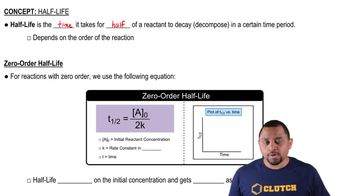
Half-life is the time required for half of the radioactive nuclei in a sample to decay. For C-14, this period is 5715 years, meaning that after this time, only half of the original amount remains. This concept is crucial for understanding the decay process and calculating the remaining quantity of a radioactive substance over time.
Recommended video:
Guided course
Zero-Order Half-life
Exponential Decay
Exponential decay describes the process by which a quantity decreases at a rate proportional to its current value. In the context of radioactive decay, the amount of C-14 decreases exponentially over time, which can be mathematically represented by the equation N(t) = N0 * (1/2)^(t/T), where N0 is the initial amount, t is the elapsed time, and T is the half-life.
Recommended video:
Guided course
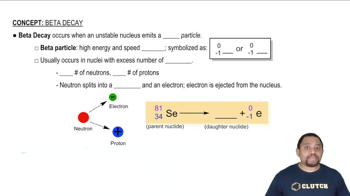
Beta Decay
Radioactive Decay Formula
The radioactive decay formula allows us to calculate the remaining quantity of a radioactive isotope after a certain period. For C-14, using the initial amount and the half-life, we can determine how much remains after a specific time by applying the formula N(t) = N0 * (1/2)^(t/T), where t is the time elapsed and T is the half-life of the isotope.
Related Practice
Textbook Question
Textbook Question
The rate constant (k) for a reaction was measured as a function of temperature. A plot of ln k versus 1/T (in K) is linear and has a slope of -7012 K. Calculate the activation energy for the reaction.
Textbook Question
The diagram shows the energy of a reaction as the reaction progresses. Label each blank box in the diagram.
a. reactants b. products c. activation energy (Ea) d. enthalpy of reaction (ΔHrxn)
2043
views
Textbook Question
The half-life for the radioactive decay of C-14 is 5715 years and is independent of the initial concentration. How long does it take for 25.00% of the C-14 atoms in a sample of C-14 to decay?
Textbook Question
The activation energy of a reaction is 44.2 kJ/mol and the frequency factor is 1.9⨉1011/ s. Calculate the rate constant of the reaction at 25 °C.
1
views
