
Carbon monoxide replaces oxygen in oxygenated hemoglobin according to the reaction: HbO2(aq) + CO(aq) ⇌ HbCO(aq) + O2(aq) a. Use the reactions and associated equilibrium constants at body temperature given here to find the equilibrium constant for the reaction just shown. Hb(aq) + O2(aq) ⇌ HbO2(aq) Kc = 1.8 Hb(aq) + CO(aq) ⇌ HbCO(aq) Kc = 306
Ch.16 - Chemical Equilibrium

Chapter 16, Problem 81
At 650 K, the reaction MgCO3(s) ⇌ MgO(s) + CO2(g) has Kp = 0.026. A 10.0-L container at 650 K has 1.0 g of MgO(s) and CO2 at P = 0.0260 atm. The container is then compressed to a volume of 0.100 L. Find the mass of MgCO3 that is formed.
Verified step by step guidance1
Calculate the initial moles of CO2 using the ideal gas law equation: PV = nRT. Here, P is the initial pressure of CO2, V is the initial volume, R is the gas constant (0.0821 L atm K^{-1} mol^{-1}), and T is the temperature in Kelvin.
Determine the new pressure of CO2 after the volume is changed to 0.100 L using the equation P1V1 = P2V2, where P1 and V1 are the initial pressure and volume, and P2 and V2 are the final pressure and volume.
Use the expression for the equilibrium constant Kp = \(\frac{P_{CO2}\)}{1} to find the new equilibrium partial pressure of CO2. Rearrange the equation to solve for P_{CO2} at equilibrium.
Calculate the change in moles of CO2 from the initial state to the equilibrium state using the difference in initial moles of CO2 and moles of CO2 at equilibrium.
Convert the change in moles of CO2 to mass of MgCO3 formed using the molar mass of MgCO3. The stoichiometry of the reaction indicates that 1 mole of CO2 corresponds to 1 mole of MgCO3.

Verified video answer for a similar problem:
This video solution was recommended by our tutors as helpful for the problem above.
Video duration:
8mWas this helpful?
Key Concepts
Here are the essential concepts you must grasp in order to answer the question correctly.
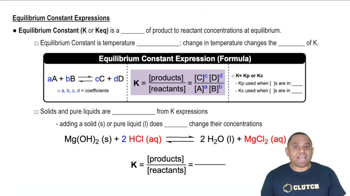
Equilibrium Constant (Kp)
The equilibrium constant (Kp) is a numerical value that expresses the ratio of the partial pressures of the products to the reactants at equilibrium for a given reaction at a specific temperature. In this case, Kp = 0.026 indicates that at 650 K, the reaction favors the formation of reactants over products. Understanding Kp is essential for predicting how changes in conditions, such as pressure and volume, will affect the position of equilibrium.
Recommended video:
Guided course
Equilibrium Constant Expressions
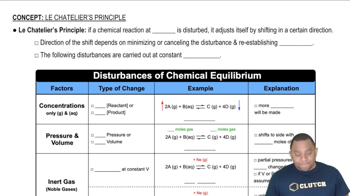
Le Chatelier's Principle
Le Chatelier's Principle states that if a dynamic equilibrium is disturbed by changing the conditions, the system will adjust itself to counteract the change and restore a new equilibrium. In this scenario, compressing the container decreases the volume, which increases the pressure. According to Le Chatelier's Principle, the system will shift towards the side with fewer moles of gas to reduce the pressure, influencing the formation of MgCO3.
Recommended video:
Guided course
Le Chatelier's Principle
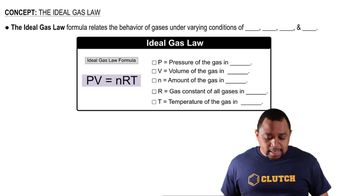
Ideal Gas Law
The Ideal Gas Law (PV = nRT) relates the pressure (P), volume (V), number of moles (n), the ideal gas constant (R), and temperature (T) of a gas. This law is crucial for calculating the number of moles of CO2 present in the container before and after compression. By using the initial conditions and the new volume, one can determine how the concentration of gases changes, which is necessary for calculating the mass of MgCO3 formed.
Recommended video:
Guided course
Ideal Gas Law Formula
Related Practice
Textbook Question
2555
views
Textbook Question
Consider the endothermic reaction: C2H4(g) + I2(g) ⇌ C2H4I2(g) If you were trying to maximize the amount of C2H4I2 produced, which tactic might you try? Assume that the reaction mixture reaches equilibrium. a. decreasing the reaction volume b. removing I2 from the reaction mixture c. raising the reaction temperature d. adding C2H4 to the reaction mixture
1517
views
Textbook Question
Coal, which is primarily carbon, can be converted to natural gas, primarily CH4, by the exothermic reaction: C(s) + 2 H2(g) ⇌ CH4(g) Which disturbance will favor CH4 at equilibrium? c. raising the temperature of the reaction mixture
1688
views
