
Carbon monoxide replaces oxygen in oxygenated hemoglobin according to the reaction: HbO2(aq) + CO(aq) ⇌ HbCO(aq) + O2(aq) a. Use the reactions and associated equilibrium constants at body temperature given here to find the equilibrium constant for the reaction just shown. Hb(aq) + O2(aq) ⇌ HbO2(aq) Kc = 1.8 Hb(aq) + CO(aq) ⇌ HbCO(aq) Kc = 306

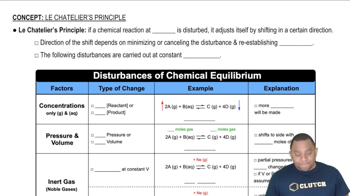
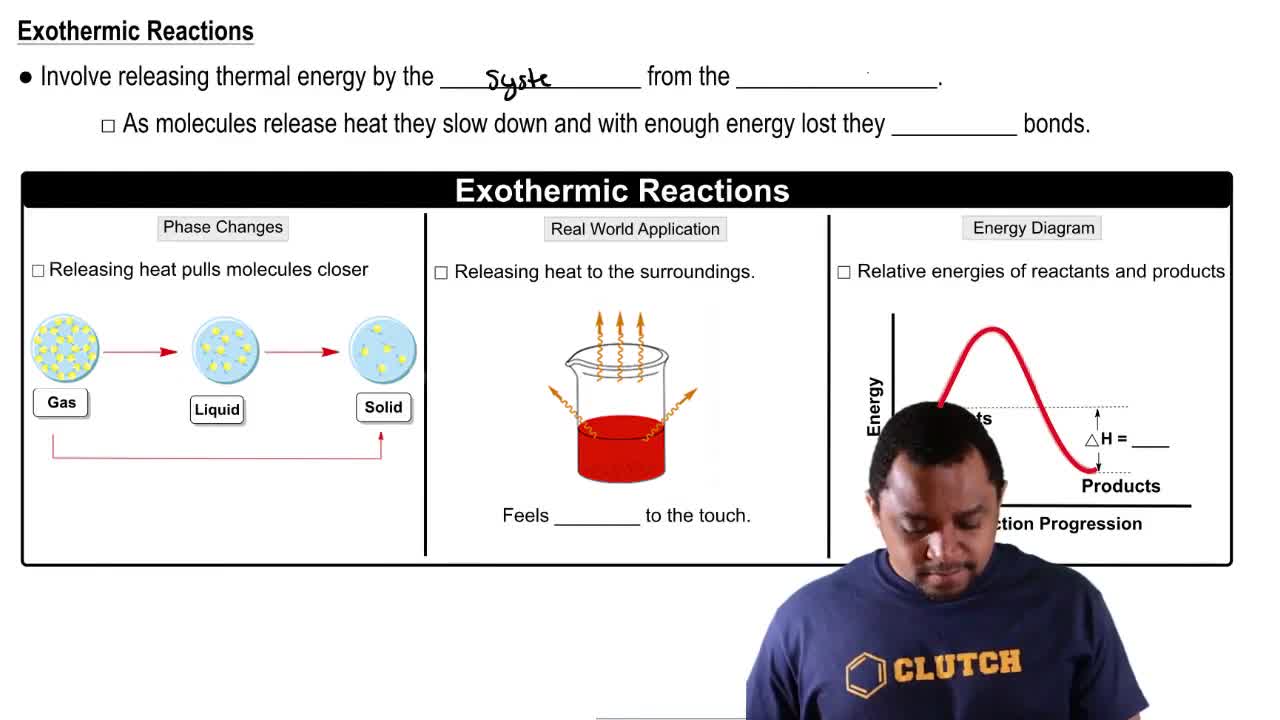
Coal, which is primarily carbon, can be converted to natural gas, primarily CH4, by the exothermic reaction: C(s) + 2 H2(g) ⇌ CH4(g) Which disturbance will favor CH4 at equilibrium? c. raising the temperature of the reaction mixture
Verified step by step guidance
Verified video answer for a similar problem:
Key Concepts
Le Chatelier's Principle
Exothermic Reactions
Equilibrium Constant (K)
At 650 K, the reaction MgCO3(s) ⇌ MgO(s) + CO2(g) has Kp = 0.026. A 10.0-L container at 650 K has 1.0 g of MgO(s) and CO2 at P = 0.0260 atm. The container is then compressed to a volume of 0.100 L. Find the mass of MgCO3 that is formed.
Coal, which is primarily carbon, can be converted to natural gas, primarily CH4, by the exothermic reaction: C(s) + 2 H2(g) ⇌ CH4(g) Which disturbance will favor CH4 at equilibrium?
a. adding more C to the reaction mixture b. adding more H2 to the reaction mixture d. lowering the volume of the reaction mixture f. adding neon gas to the reaction mixture
Each reaction is allowed to come to equilibrium, and then the volume is changed as indicated. Predict the effect (shift right, shift left, or no effect) of the indicated volume change. b. PCl3(g) + Cl2(g) ⇌ PCl5(g) (volume is increased)
This reaction is endothermic. C(s) + CO2(g) ⇌ 2 CO(g) Predict the effect (shift right, shift left, or no effect) of increasing and decreasing the reaction temperature. How does the value of the equilibrium constant depend on temperature?
