A 100.0-mL buffer solution is 0.175 M in HClO and 0.150 M in NaClO. c. What is the pH after addition of 85.0 mg of NaOH?
Ch.18 - Aqueous Ionic Equilibrium

Chapter 18, Problem 54
A 100.0-mL buffer solution is 0.100 M in NH3 and 0.125 M in NH4Br. What mass of HCl can this buffer neutralize before the pH falls below 9.00?
Verified step by step guidance1
First, we need to calculate the pOH from the given pH. We can use the formula pOH = 14 - pH.
Next, we need to calculate the concentration of OH- ions using the formula [OH-] = 10^-pOH.
Then, we need to calculate the concentration of NH3 in the buffer solution. We know that the concentration of NH3 is 0.100 M.
Now, we need to calculate the concentration of NH4+ ions in the buffer solution. We know that the concentration of NH4+ is 0.125 M.
Finally, we can calculate the mass of HCl that the buffer can neutralize. We know that the reaction between NH3 and HCl produces NH4+ and Cl-. Therefore, the amount of HCl that can be neutralized is equal to the amount of NH3 present in the buffer. We can use the formula mass = volume x concentration x molar mass to calculate the mass of HCl.

Verified video answer for a similar problem:
This video solution was recommended by our tutors as helpful for the problem above.
Video duration:
5mWas this helpful?
Key Concepts
Here are the essential concepts you must grasp in order to answer the question correctly.
Buffer Solutions
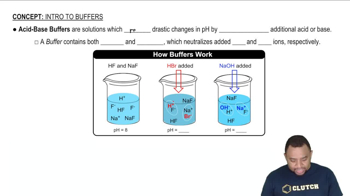
Buffer solutions are mixtures that resist changes in pH when small amounts of acid or base are added. They typically consist of a weak acid and its conjugate base or a weak base and its conjugate acid. In this case, the NH3/NH4Br system acts as a buffer, maintaining the pH around 9.00 despite the addition of HCl.
Recommended video:
Guided course
Buffer Solutions
Henderson-Hasselbalch Equation
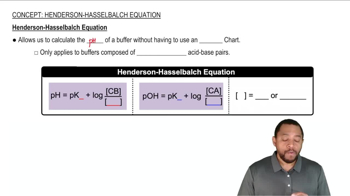
The Henderson-Hasselbalch equation relates the pH of a buffer solution to the concentration of its acidic and basic components. It is expressed as pH = pKa + log([A-]/[HA]). For the NH3/NH4+ buffer, knowing the pKa allows us to calculate how much HCl can be added before the pH drops below a specified value.
Recommended video:
Guided course
Henderson-Hasselbalch Equation
Neutralization Reaction
A neutralization reaction occurs when an acid reacts with a base to form water and a salt. In this scenario, HCl (strong acid) will react with NH3 (weak base) to form NH4Cl and water. The extent of this reaction determines how much HCl can be added to the buffer before the pH changes significantly.
Recommended video:
Guided course
Lewis Dot Structures: Neutral Compounds
Related Practice
Textbook Question
900
views
Textbook Question
Determine whether or not the mixing of each pair of solutions results in a buffer. d. 105.0 mL of 0.12 M CH3NH2 ; 110.0 mL of 0.15 M CH3NH3Cl
Textbook Question
For each solution, calculate the initial and final pH after adding 0.010 mol of NaOH. a. 250.0 mL of pure water b. 250.0 mL of a buffer solution that is 0.195 M in HCHO2 and 0.275 M in KCHO2 c. 250.0 mL of a buffer solution that is 0.255 M in CH3CH2NH2 and 0.235 M in CH3CH2NH3Cl
1489
views
Textbook Question
Determine whether or not the mixing of each pair of solutions results in a buffer. a. 155.0 mL of 0.15 M NH3 ; 175.0 mL of 0.17 M HCl
Textbook Question
Determine whether or not the mixing of each pair of solutions results in a buffer. c. 55.0 mL of 0.15 M HF; 85.0 mL of 0.10 M NaF