
Textbook Question
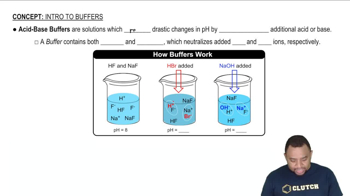
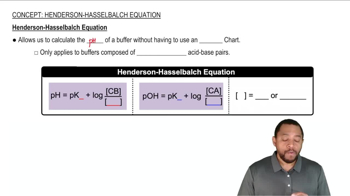
Determine whether or not the mixing of each pair of solutions results in a buffer. b.155.0 mL of 0.15 M NH3 ; 155.0 mL of 0.10 M HCl

 Verified step by step guidance
 03:02
03:02
 02:40
02:40Determine whether or not the mixing of each pair of solutions results in a buffer. b.155.0 mL of 0.15 M NH3 ; 155.0 mL of 0.10 M HCl
Determine whether or not the mixing of each pair of solutions results in a buffer. d. 105.0 mL of 0.12 M CH3NH2 ; 110.0 mL of 0.15 M CH3NH3Cl
Determine whether or not the mixing of each pair of solutions results in a buffer. c. 225.0 mL of 0.10 M NH3 ; 250.0 mL of 0.15 M NH4Cl
A 100.0-mL buffer solution is 0.100 M in NH3 and 0.125 M in NH4Br. What mass of HCl can this buffer neutralize before the pH falls below 9.00?
For each solution, calculate the initial and final pH after adding 0.010 mol of NaOH. a. 250.0 mL of pure water b. 250.0 mL of a buffer solution that is 0.195 M in HCHO2 and 0.275 M in KCHO2 c. 250.0 mL of a buffer solution that is 0.255 M in CH3CH2NH2 and 0.235 M in CH3CH2NH3Cl
Determine whether or not the mixing of each pair of solutions results in a buffer. a. 155.0 mL of 0.15 M NH3 ; 175.0 mL of 0.17 M HCl