
Textbook Question
Indicate and explain the sign of ΔSuniv for each process. a. 2 H2(g) + O2(g) → 2 H2O (l) at 298 K.
549
views
2
comments

 Verified step by step guidance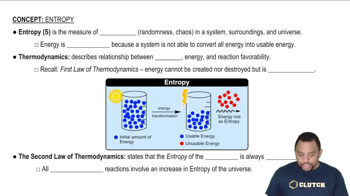
 02:46
02:46
 00:48
00:48Indicate and explain the sign of ΔSuniv for each process. a. 2 H2(g) + O2(g) → 2 H2O (l) at 298 K.
A metal salt with the formula MCl2 crystallizes from water to form a solid with the composition MCl2 • 6 H2O. The equilibrium vapor pressure of water above this solid at 298 K is 18.3 mmHg. What is the value of ΔG for the reaction MCl2 • 6 H2O(s) ⇌ MCl2(s) + 6 H2O(g) when the pressure of water vapor is 18.3 mmHg? When the pressure of water vapor is 760 mmHg?
All the oxides of nitrogen have positive values of ΔG°f at 298 K, but only one common oxide of nitrogen has a positive ΔS°f. Identify that oxide of nitrogen without reference to thermodynamic data and explain.
Determine the minimum concentration of the precipitating agent on the right to cause precipitation of the cation from the solution on the left. a. 0.035 M Ba(NO3)2; NaF
The values of ΔG°f for the hydrogen halides become less negative with increasing atomic number. The ΔG°f of HI is slightly positive. However, the trend in ΔS°f is to become more positive with increasing atomic number. Explain.