
Epsom salts is a hydrated ionic compound with the following formula: MgSO4 • x H2O. A 4.93-g sample of Epsom salts is heated to drive off the water of hydration. The mass of the sample after complete dehydration is 2.41 g. Find the number of waters of hydration (x) in Epsom salts.

A compound of molar mass 177 g/mol contains only carbon, hydrogen, bromine, and oxygen. Analysis reveals that the compound contains eight times as much carbon as hydrogen by mass. Find the molecular formula.
Verified step by step guidance
Verified video answer for a similar problem:
Key Concepts
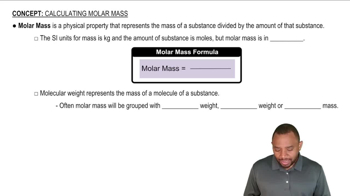
Molar Mass
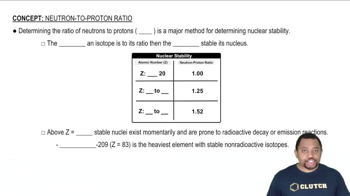
Mass Ratio
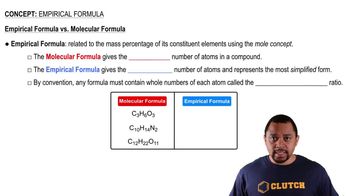
Empirical and Molecular Formulas
A hydrate of copper(II) chloride has the following formula: CuCl2 • x H2O. The water in a 3.41-g sample of the hydrate is driven off by heating. The remaining sample has a mass of 2.69 g. Find the number of waters of hydration (x) in the hydrate.
Find the total number of atoms in a sample of cocaine hydrochloride, C17H22ClNO4, of mass 23.5 mg.
The chloride of an unknown metal is believed to have the formula MCl3. A 2.395-g sample of the compound contains 3.606×10⁻² mol Cl. Find the atomic mass of M.
Estrone, which contains only carbon, hydrogen, and oxygen, is a female sexual hormone in the urine of pregnant women. Combustion analysis of a 1.893-g sample of estrone produces 5.545 g of CO2 and 1.388 g H2O. The molar mass of estrone is 270.36 g/mol. Find its molecular formula.
Researchers obtained the following data from experiments to find the molecular formula of benzocaine, a local anesthetic, which contains only carbon, hydrogen, nitrogen, and oxygen. Complete combustion of a 3.54-g sample of benzocaine with excess O2 forms 8.49 g of CO2 and 2.14 g H2O. Another 2.35-g sample contains 0.199 g of N. The molar mass of benzocaine is 165 g/mol. Find the molar formula of benzocaine.
