Ch.3 - Molecules and Compounds
Tro - Chemistry: A Molecular Approach 6th Edition
Tro6th EditionChemistry: A Molecular ApproachISBN: 9780137832217Not the one you use?Change textbook
Chapter 3, Problem 135

Find the total number of atoms in a sample of cocaine hydrochloride, C17H22ClNO4, of mass 23.5 mg.

Verified step by step guidance
1
Convert the mass of the cocaine hydrochloride from milligrams to grams. Remember that 1 mg equals 0.001 grams.
Calculate the molar mass of cocaine hydrochloride, C17H22ClNO4. Use the atomic masses of carbon (C), hydrogen (H), chlorine (Cl), nitrogen (N), and oxygen (O) from the periodic table to find the sum.
Use the molar mass to convert the mass of the cocaine hydrochloride sample from grams to moles. Use the formula: \( \text{moles} = \frac{\text{mass in grams}}{\text{molar mass}} \).
Calculate the total number of molecules in the sample by using Avogadro's number, which is approximately \(6.022 \times 10^{23}\) molecules per mole. Multiply the number of moles by Avogadro's number.
Determine the total number of atoms in a molecule of cocaine hydrochloride. Since the formula is C17H22ClNO4, add up the atoms: 17 carbon atoms, 22 hydrogen atoms, 1 chlorine atom, 1 nitrogen atom, and 4 oxygen atoms. Multiply the total number of molecules by the total number of atoms per molecule to find the total number of atoms in the sample.

Verified video answer for a similar problem:

This video solution was recommended by our tutors as helpful for the problem above.
Video duration:
6m
Was this helpful?

Key Concepts

Here are the essential concepts you must grasp in order to answer the question correctly.

Molecular Formula

The molecular formula of a compound provides the types and numbers of atoms present in a molecule. For cocaine hydrochloride, C17H22ClNO4, the formula indicates it contains 17 carbon (C) atoms, 22 hydrogen (H) atoms, 1 chlorine (Cl) atom, 1 nitrogen (N) atom, and 4 oxygen (O) atoms. Understanding the molecular formula is essential for determining the total number of atoms in a given mass of the substance.

Molar Mass

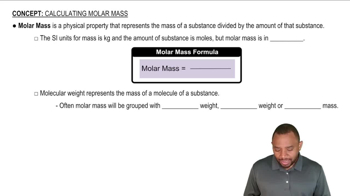
Molar mass is the mass of one mole of a substance, typically expressed in grams per mole (g/mol). To find the total number of atoms in a sample, one must first calculate the molar mass of cocaine hydrochloride by summing the atomic masses of all atoms in its molecular formula. This value allows for the conversion of the sample's mass into moles, which is crucial for further calculations.
Recommended video:
Guided course
02:11
Molar Mass Concept

Avogadro's Number

Avogadro's number, approximately 6.022 x 10^23, is the number of particles (atoms, molecules, etc.) in one mole of a substance. Once the number of moles of cocaine hydrochloride is determined from the sample's mass and its molar mass, Avogadro's number can be used to calculate the total number of individual atoms in the sample. This concept is fundamental in bridging the macroscopic and microscopic worlds in chemistry.
Related Practice
Textbook Question

Write the structural formulas of three different compounds that each have the molecular formula C5H12.

1164
views

Textbook Question

A hydrate of copper(II) chloride has the following formula: CuCl2 • x H2O. The water in a 3.41-g sample of the hydrate is driven off by heating. The remaining sample has a mass of 2.69 g. Find the number of waters of hydration (x) in the hydrate.

3683
views
Textbook Question

A compound of molar mass 177 g/mol contains only carbon, hydrogen, bromine, and oxygen. Analysis reveals that the compound contains eight times as much carbon as hydrogen by mass. Find the molecular formula.

1765
views
Textbook Question

The chloride of an unknown metal is believed to have the formula MCl3. A 2.395-g sample of the compound contains 3.606×10⁻² mol Cl. Find the atomic mass of M.

3339
views
1
rank
1
comments
Textbook Question

A particular brand of beef jerky contains 0.0552% sodium nitrite by mass and is sold in an 8.00-oz bag. What mass of sodium does the sodium nitrite contribute to the sodium content of the bag of beef jerky?

1303
views
1
comments
Textbook Question

Researchers obtained the following data from experiments to find the molecular formula of benzocaine, a local anesthetic, which contains only carbon, hydrogen, nitrogen, and oxygen. Complete combustion of a 3.54-g sample of benzocaine with excess O2 forms 8.49 g of CO2 and 2.14 g H2O. Another 2.35-g sample contains 0.199 g of N. The molar mass of benzocaine is 165 g/mol. Find the molar formula of benzocaine.

1229
views
1
rank