Write the balanced chemical equation for each reaction. a. Solid copper reacts with solid sulfur to form solid copper(I) sulfide.
Ch.4 - Chemical Reactions and Chemical Quantities

Chapter 4, Problem 21c
Write the balanced chemical equation for each reaction. c. Aqueous hydrochloric acid reacts with solid manganese(IV) oxide to form aqueous manganese(II) chloride, liquid water, and chlorine gas.
Verified step by step guidance1
Identify the reactants and products in the chemical reaction: Reactants are hydrochloric acid (HCl) and manganese(IV) oxide (MnO2). Products are manganese(II) chloride (MnCl2), water (H2O), and chlorine gas (Cl2).
Write the unbalanced chemical equation using the chemical formulas: HCl(aq) + MnO2(s) -> MnCl2(aq) + H2O(l) + Cl2(g).
Balance the equation by adjusting coefficients to ensure the same number of each type of atom on both sides of the equation. Start by balancing the manganese (Mn) atoms.
Next, balance the chlorine (Cl) atoms. Since Cl appears in both HCl and Cl2, adjust the coefficients accordingly.
Finally, balance the hydrogen (H) and oxygen (O) atoms by adjusting the coefficients of HCl and H2O.

Verified video answer for a similar problem:
This video solution was recommended by our tutors as helpful for the problem above.
Video duration:
1mWas this helpful?
Key Concepts
Here are the essential concepts you must grasp in order to answer the question correctly.
Balancing Chemical Equations
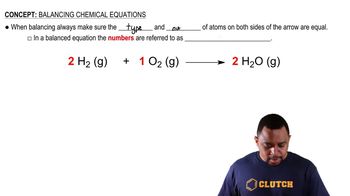
Balancing chemical equations involves ensuring that the number of atoms for each element is the same on both the reactant and product sides. This is based on the law of conservation of mass, which states that matter cannot be created or destroyed in a chemical reaction. Each side of the equation must have equal numbers of each type of atom, which often requires adjusting coefficients in front of the chemical formulas.
Recommended video:
Guided course
Balancing Chemical Equations
Types of Chemical Reactions
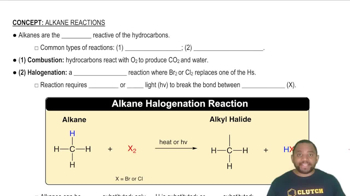
Chemical reactions can be classified into several types, including synthesis, decomposition, single replacement, and double replacement reactions. The reaction described involves an acid reacting with a metal oxide, which typically falls under the category of an acid-base reaction. Understanding the type of reaction helps predict the products formed and the overall behavior of the reactants.
Recommended video:
Guided course
Common Types of Alkane Reactions
Chemical Formulas and States of Matter
Chemical formulas represent the composition of substances, indicating the types and numbers of atoms involved. In the given reaction, the states of matter are also important: aqueous (aq) indicates a substance dissolved in water, solid (s) indicates a solid, liquid (l) indicates a liquid, and gas (g) indicates a gaseous state. Recognizing these states helps in understanding the physical changes that occur during the reaction.
Related Practice
Textbook Question
2046
views
Textbook Question
Write the balanced chemical equation for each reaction. b. Solid iron(III) oxide reacts with hydrogen gas to form solid iron and liquid water.
4040
views
1
comments
Textbook Question
When iron rusts, solid iron reacts with gaseous oxygen to form solid iron(III) oxide. Write the balanced chemical equation for this reaction.
1864
views
Textbook Question
Write the balanced chemical equation for each reaction.
c. Sulfur dioxide gas reacts with oxygen gas to form sulfur trioxide gas.
d. Gaseous ammonia (NH3) reacts with gaseous oxygen to form gaseous nitrogen monoxide and gaseous water.
1344
views
Textbook Question
Write the balanced chemical equation for the fermentation of sucrose (C12H22O11) by yeasts in which the aqueous sugar reacts with water to form aqueous ethanol (C2H5OH) and carbon dioxide gas.
1393
views