Write the balanced chemical equation for the reaction of aqueous potassium hydroxide with aqueous iron(III) chloride to form solid iron(III) hydroxide and aqueous potassium chloride.
Ch.4 - Chemical Reactions and Chemical Quantities

Chapter 4, Problem 22d
Write the balanced chemical equation for each reaction.
c. Sulfur dioxide gas reacts with oxygen gas to form sulfur trioxide gas.
d. Gaseous ammonia (NH3) reacts with gaseous oxygen to form gaseous nitrogen monoxide and gaseous water.
Verified step by step guidance1
Identify the reactants and products in the chemical reaction: Reactants are NH_3 (ammonia) and O_2 (oxygen), and products are NO (nitrogen monoxide) and H_2O (water).
Write the unbalanced chemical equation using the chemical formulas: NH_3 + O_2 \(\rightarrow\) NO + H_2O.
Balance the nitrogen atoms: There is 1 nitrogen atom in NH_3 and 1 in NO, so they are already balanced.
Balance the hydrogen atoms: There are 3 hydrogen atoms in NH_3 and 2 in H_2O. To balance, place a coefficient of 2 in front of NH_3 and a coefficient of 3 in front of H_2O.
Balance the oxygen atoms: After balancing hydrogen, there are 2 oxygen atoms in NO and 3 in H_2O, totaling 5 oxygen atoms. Place a coefficient of \(\frac{5}{2}\) in front of O_2, or alternatively, double all coefficients to avoid fractions.

Verified video answer for a similar problem:
This video solution was recommended by our tutors as helpful for the problem above.
Video duration:
1mWas this helpful?
Key Concepts
Here are the essential concepts you must grasp in order to answer the question correctly.
Balancing Chemical Equations
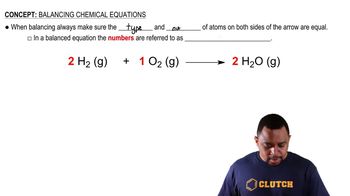
Balancing chemical equations involves ensuring that the number of atoms for each element is the same on both the reactant and product sides. This is based on the law of conservation of mass, which states that matter cannot be created or destroyed in a chemical reaction. To balance an equation, coefficients are adjusted in front of the chemical formulas.
Recommended video:
Guided course
Balancing Chemical Equations
Chemical Reaction Types
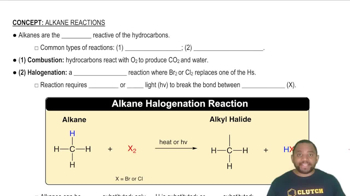
The reaction described is a combustion reaction, where a substance reacts with oxygen to produce energy, typically in the form of heat and light. In this case, ammonia (NH3) reacts with oxygen (O2) to produce nitrogen monoxide (NO) and water (H2O). Understanding the type of reaction helps in predicting the products and balancing the equation.
Recommended video:
Guided course
Common Types of Alkane Reactions
Stoichiometry
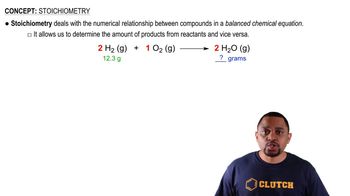
Stoichiometry is the calculation of reactants and products in chemical reactions based on their molar ratios. It allows chemists to determine how much of each substance is needed or produced in a reaction. In balancing the equation for the reaction between ammonia and oxygen, stoichiometric coefficients will be used to ensure that the number of atoms of each element is conserved.
Recommended video:
Guided course
Stoichiometry Concept
Related Practice
Textbook Question
925
views
Textbook Question
Write the balanced chemical equation for each reaction. a. Solid copper reacts with solid sulfur to form solid copper(I) sulfide.
2046
views
Textbook Question
Balance each chemical equation. b. Co(NO3)3(aq) + (NH4)2S(aq) → Co2S3(s) + NH4NO3(aq)
1403
views
Textbook Question
Write the balanced chemical equation for each reaction. b. Solid iron(III) oxide reacts with hydrogen gas to form solid iron and liquid water.
4040
views
1
comments
Textbook Question
Balance the equation and calculate how many moles of O2 form when each quantity of reactant completely reacts. N2O5( g) → NO2(g) + O2(g) a. 1.2 mol N2O5
Textbook Question
Write the balanced chemical equation for each reaction. c. Aqueous hydrochloric acid reacts with solid manganese(IV) oxide to form aqueous manganese(II) chloride, liquid water, and chlorine gas.
1451
views