
Textbook Question
Write the balanced chemical equation for each reaction. a. Solid copper reacts with solid sulfur to form solid copper(I) sulfide.
2046
views

 Verified step by step guidance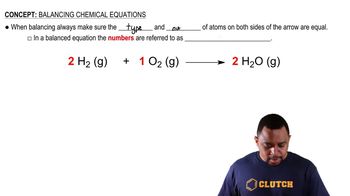
 01:32
01:32
 02:25
02:25 00:28
00:28Write the balanced chemical equation for each reaction. a. Solid copper reacts with solid sulfur to form solid copper(I) sulfide.
Balance each chemical equation. b. Co(NO3)3(aq) + (NH4)2S(aq) → Co2S3(s) + NH4NO3(aq)
Write the balanced chemical equation for each reaction. b. Solid iron(III) oxide reacts with hydrogen gas to form solid iron and liquid water.
Write the balanced chemical equation for each reaction.
c. Sulfur dioxide gas reacts with oxygen gas to form sulfur trioxide gas.
d. Gaseous ammonia (NH3) reacts with gaseous oxygen to form gaseous nitrogen monoxide and gaseous water.
Balance the equation and calculate how many moles of O2 form when each quantity of reactant completely reacts. N2O5( g) → NO2(g) + O2(g) a. 1.2 mol N2O5
Balance the equation and calculate how many moles of N2 form when each quantity of reactant completely reacts. N2H4(l) → NH3(g) + N2(g) c. 33.9 g N2H4