A sample of CO2 effuses from a container in 55 seconds. How long will it take the same amount of gaseous Xe to effuse from the same container under identical conditions?
Ch.6 - Gases

Chapter 6, Problem 95
A sample of argon effuses from a container in 112 seconds. The same amount of an unknown noble gas requires 79.6 seconds. Identify the second gas.
Verified step by step guidance1
Identify the principle involved: Graham's Law of Effusion, which states that the rate of effusion of a gas is inversely proportional to the square root of its molar mass.
Write the formula for Graham's Law: \( \frac{\text{Rate}_1}{\text{Rate}_2} = \sqrt{\frac{M_2}{M_1}} \), where Rate is the rate of effusion and M is the molar mass.
Since the same amount of gas is used, the rate of effusion is inversely proportional to the time taken. Therefore, \( \frac{t_2}{t_1} = \sqrt{\frac{M_2}{M_1}} \), where \( t_1 \) and \( t_2 \) are the times for argon and the unknown gas, respectively.
Substitute the given times into the equation: \( \frac{79.6}{112} = \sqrt{\frac{M_2}{39.95}} \), where 39.95 g/mol is the molar mass of argon.
Solve for \( M_2 \), the molar mass of the unknown gas, by squaring both sides and rearranging the equation.

Verified video answer for a similar problem:
This video solution was recommended by our tutors as helpful for the problem above.
Video duration:
3mWas this helpful?
Key Concepts
Here are the essential concepts you must grasp in order to answer the question correctly.
Graham's Law of Effusion
Graham's Law states that the rate of effusion of a gas is inversely proportional to the square root of its molar mass. This means that lighter gases effuse faster than heavier gases. The relationship can be expressed mathematically as (Rate1/Rate2) = √(Molar Mass2/Molar Mass1), allowing for the comparison of effusion rates between two gases.
Recommended video:
Guided course
Graham's Law of Effusion
Molar Mass
Molar mass is the mass of one mole of a substance, typically expressed in grams per mole (g/mol). It is a critical factor in determining the behavior of gases, including their rates of effusion. In this context, knowing the molar mass of argon (approximately 40 g/mol) helps in calculating the molar mass of the unknown noble gas based on its effusion time.
Recommended video:
Guided course
Molar Mass Concept
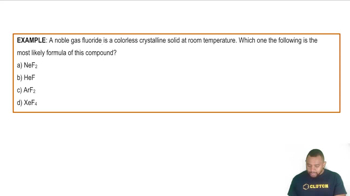
Noble Gases
Noble gases are a group of elements in Group 18 of the periodic table, known for their low reactivity due to having a full valence shell. Common noble gases include helium, neon, argon, krypton, xenon, and radon. Identifying the unknown gas involves comparing its molar mass to those of the noble gases, which can be inferred from the effusion data provided.
Recommended video:
Guided course
Noble Gas Compounds Example
Related Practice
Textbook Question
1
views
Textbook Question
Calculate the root mean square velocity and kinetic energy of CO, CO2, and SO3 at 298 K. Which gas has the greatest velocity? The greatest kinetic energy? The greatest effusion rate?
2059
views
1
comments
Textbook Question
Which postulate of the kinetic molecular theory breaks down under conditions of high pressure? Explain.
1232
views
Textbook Question
The graph shows the distribution of molecular velocities for the same molecule at two different temperatures (T1 and T2). Which temperature is greater? Explain.
602
views
Textbook Question
Calculate the root mean square velocity and kinetic energy of F2, Cl2, and Br2 at 298 K. Rank these three halogens with respect to their rate of effusion.
1206
views
Textbook Question
Calculate the ratio of effusion rates for Ar and Kr.
1313
views