A sample of CO2 effuses from a container in 55 seconds. How long will it take the same amount of gaseous Xe to effuse from the same container under identical conditions?
Ch.6 - Gases

Chapter 6, Problem 94
Calculate the ratio of effusion rates for Ar and Kr.
Verified step by step guidance1
Identify the formula for the rate of effusion, which is given by Graham's law: \( \frac{\text{Rate of effusion of gas 1}}{\text{Rate of effusion of gas 2}} = \sqrt{\frac{M_2}{M_1}} \), where \( M_1 \) and \( M_2 \) are the molar masses of the gases.
Assign the gases to the variables: let gas 1 be Argon (Ar) and gas 2 be Krypton (Kr).
Find the molar masses of Argon and Krypton. Argon (Ar) has a molar mass of approximately 39.95 g/mol, and Krypton (Kr) has a molar mass of approximately 83.80 g/mol.
Substitute the molar masses into Graham's law: \( \frac{\text{Rate of effusion of Ar}}{\text{Rate of effusion of Kr}} = \sqrt{\frac{83.80}{39.95}} \).
Simplify the expression under the square root to find the ratio of effusion rates.
Key Concepts
Here are the essential concepts you must grasp in order to answer the question correctly.
Graham's Law of Effusion
Graham's Law states that the rate of effusion of a gas is inversely proportional to the square root of its molar mass. This means that lighter gases effuse faster than heavier gases. The formula can be expressed as (Rate1/Rate2) = √(Molar Mass2/Molar Mass1), allowing for the comparison of effusion rates between two different gases.
Recommended video:
Guided course
Graham's Law of Effusion
Molar Mass
Molar mass is the mass of one mole of a substance, typically expressed in grams per mole (g/mol). It is a critical factor in calculating effusion rates, as it directly influences the speed at which a gas can escape through a small opening. For argon (Ar), the molar mass is approximately 40 g/mol, while for krypton (Kr), it is about 84 g/mol.
Recommended video:
Guided course
Molar Mass Concept
Effusion
Effusion is the process by which gas molecules escape from a container through a tiny opening into a vacuum or lower pressure area. The rate of effusion is influenced by factors such as temperature and the size of the gas molecules. Understanding effusion is essential for applying Graham's Law and comparing the behavior of different gases under similar conditions.
Recommended video:
Guided course
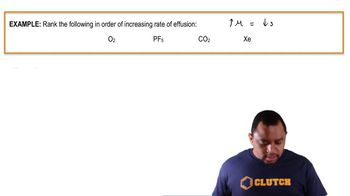
Effusion Rate Example
Related Practice
Textbook Question
1
views
Textbook Question
Calculate the root mean square velocity and kinetic energy of CO, CO2, and SO3 at 298 K. Which gas has the greatest velocity? The greatest kinetic energy? The greatest effusion rate?
2059
views
1
comments
Textbook Question
The graph shows the distribution of molecular velocities for the same molecule at two different temperatures (T1 and T2). Which temperature is greater? Explain.
602
views
Textbook Question
Calculate the root mean square velocity and kinetic energy of F2, Cl2, and Br2 at 298 K. Rank these three halogens with respect to their rate of effusion.
1206
views
Textbook Question
A sample of argon effuses from a container in 112 seconds. The same amount of an unknown noble gas requires 79.6 seconds. Identify the second gas.
Textbook Question
Calculate the root mean square velocity of F2, Cl2, and Br2 at 298 K.
2076
views
1
rank