The pressure on top of Mount Everest (29,029 ft) averages about 235 mmHg. Convert this pressure to each indicated unit. a. torr b. psi c. in Hg d. atm
Ch.6 - Gases

Chapter 6, Problem 32b
Given a barometric pressure of 751.5 mmHg, calculate the pressure of each gas sample as indicated by the manometer.
(b)
Verified step by step guidance1
Identify the type of manometer used (open or closed) to determine how to relate the barometric pressure to the gas pressure.
If it's an open manometer, note the height difference (h) between the mercury levels in the two arms of the manometer.
For an open manometer, if the mercury level is higher on the side open to the atmosphere, the gas pressure is less than the atmospheric pressure. Use the formula: P_gas = P_atm - h.
If the mercury level is higher on the side connected to the gas, the gas pressure is greater than the atmospheric pressure. Use the formula: P_gas = P_atm + h.
Substitute the given barometric pressure (751.5 mmHg) and the height difference (h) into the appropriate formula to find the pressure of the gas sample.
Key Concepts
Here are the essential concepts you must grasp in order to answer the question correctly.
Barometric Pressure
Barometric pressure is the pressure exerted by the weight of the atmosphere at a given point. It is commonly measured in units such as mmHg or atm. Understanding barometric pressure is essential for calculating the pressure of gases in various conditions, as it serves as a reference point for other pressure measurements.
Recommended video:
Guided course
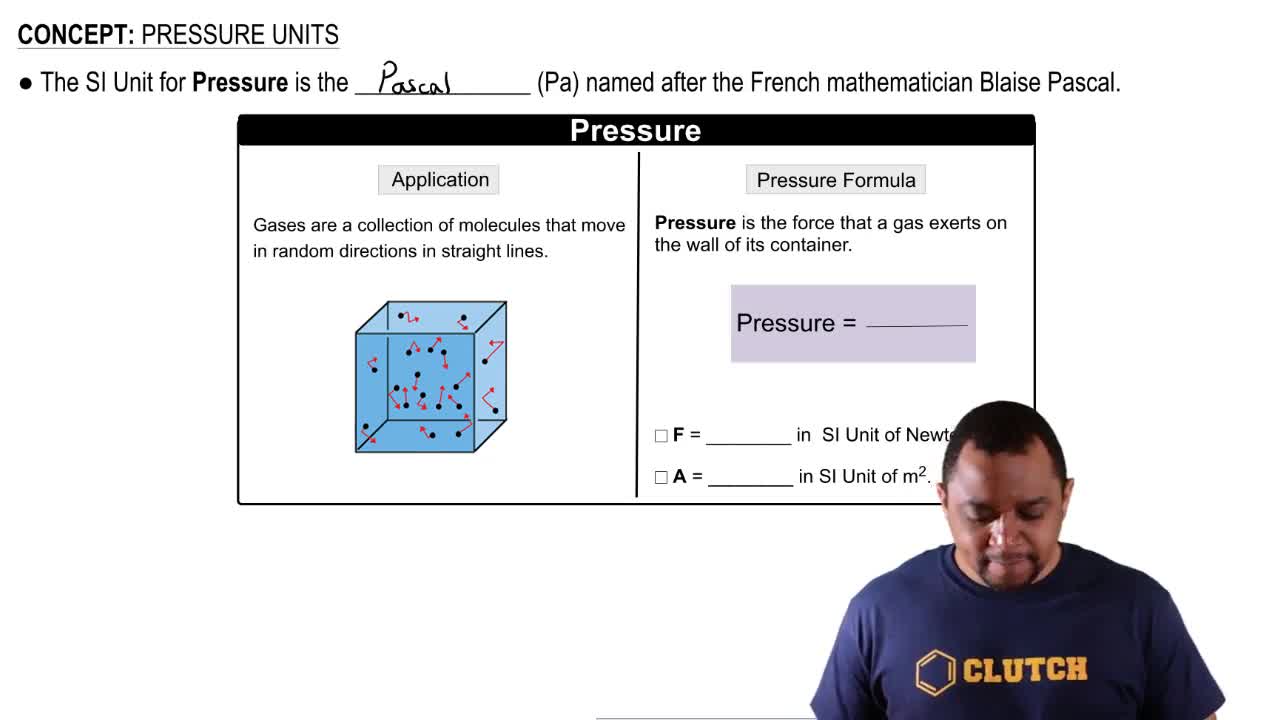
Pressure Units
Manometer
A manometer is a device used to measure the pressure of gases. It typically consists of a U-shaped tube filled with liquid, where the difference in liquid height between the two arms indicates the pressure of the gas relative to atmospheric pressure. Knowing how to read a manometer is crucial for determining the pressure of gas samples accurately.
Gas Laws
Gas laws describe the relationships between pressure, volume, temperature, and the number of moles of a gas. Key laws include Boyle's Law, which states that pressure and volume are inversely related at constant temperature, and Dalton's Law, which states that the total pressure of a mixture of gases is the sum of the partial pressures of each gas. These laws are fundamental for calculating the pressures of gas samples in various scenarios.
Recommended video:
Guided course
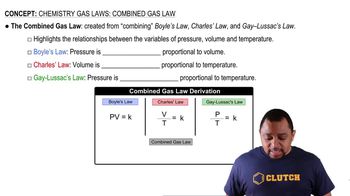
Combined Gas Law
Related Practice
Textbook Question
4565
views
1
rank
Textbook Question
A sample of gas has an initial volume of 14.1 L at a pressure of 1.05 atm. If the sample is compressed to a volume of 10.1 L (at constant temperature), what is its pressure?
Textbook Question
Given a barometric pressure of 751.5 mmHg, calculate the pressure of each gas sample as indicated by the manometer.
(a)
3686
views
1
comments
Textbook Question
The North American record for highest recorded barometric pressure is 31.85 in Hg, set in 1989 in Northway, Alaska. Convert this pressure to each indicated unit. a. mmHg
2946
views
Textbook Question
A 48.3-mL sample of gas in a cylinder is warmed from 22 °C to 87 °C. What is its volume at the final temperature?
2726
views
1
rank
1
comments
Textbook Question
A sample of gas has an initial volume of 4.20 L at a pressure of 755 mmHg. If the volume of the gas is increased to 7.10 L (at constant temperature), what is its pressure?
2
views