The pressure on top of Mount Everest (29,029 ft) averages about 235 mmHg. Convert this pressure to each indicated unit. a. torr b. psi c. in Hg d. atm
Ch.6 - Gases

Chapter 6, Problem 27a
The North American record for highest recorded barometric pressure is 31.85 in Hg, set in 1989 in Northway, Alaska. Convert this pressure to each indicated unit. a. mmHg
Verified step by step guidance1
1. The problem is asking us to convert the pressure from inches of mercury (in Hg) to millimeters of mercury (mmHg).
2. We know that 1 in Hg is approximately equal to 25.4 mmHg. This is a standard conversion factor in pressure measurements.
3. To convert the pressure from in Hg to mmHg, we simply multiply the given pressure by the conversion factor. In this case, we multiply 31.85 in Hg by 25.4 mmHg/in Hg.
4. The units of in Hg will cancel out, leaving us with the pressure in mmHg.
5. The result of this multiplication will be the pressure in mmHg.
Key Concepts
Here are the essential concepts you must grasp in order to answer the question correctly.
Barometric Pressure
Barometric pressure is the pressure exerted by the weight of the atmosphere at a given point. It is commonly measured in units such as inches of mercury (in Hg) or millimeters of mercury (mmHg). Understanding barometric pressure is essential for meteorology and various scientific applications, as it influences weather patterns and altitude measurements.
Recommended video:
Guided course
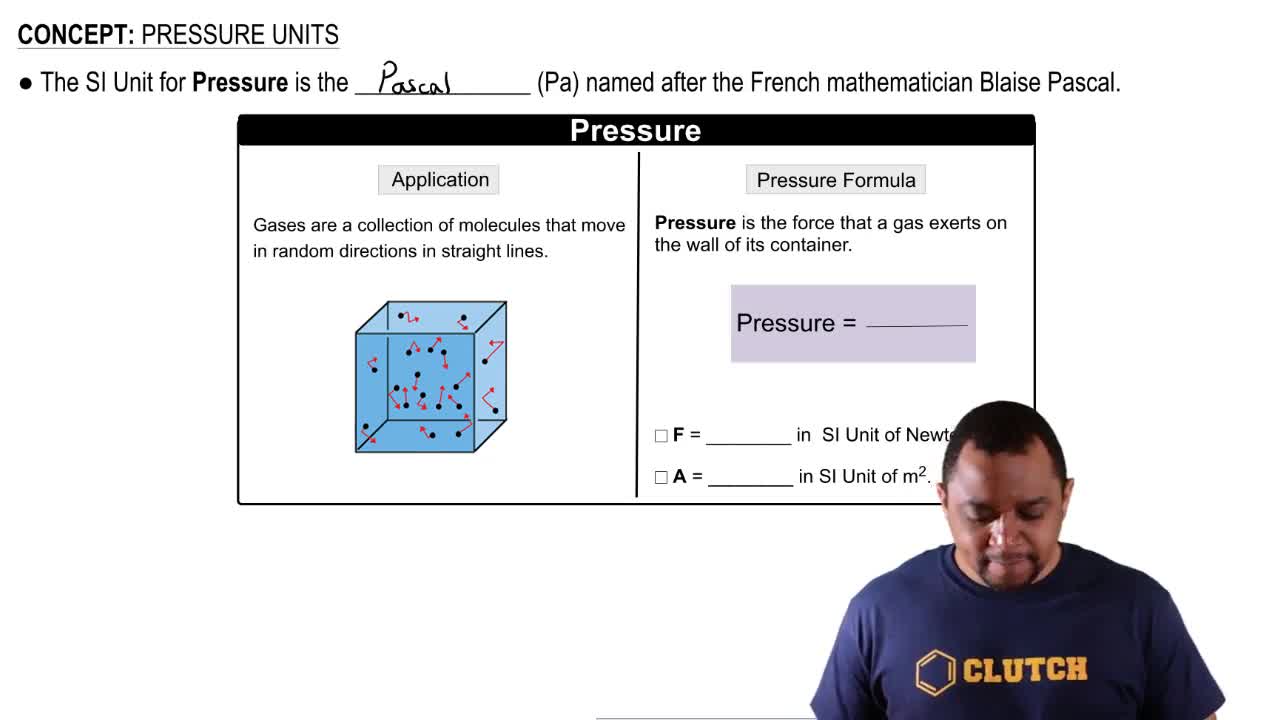
Pressure Units
Unit Conversion
Unit conversion is the process of converting a quantity expressed in one unit to another unit. In this case, converting barometric pressure from inches of mercury to millimeters of mercury involves using a conversion factor, where 1 in Hg is equivalent to 25.4 mmHg. Mastery of unit conversion is crucial in chemistry and physics to ensure accurate calculations and comparisons.
Recommended video:
Guided course
Conversion Factors
Measurement Standards
Measurement standards provide a consistent framework for quantifying physical quantities. The use of standardized units, such as the metric system for pressure measurements, ensures clarity and uniformity in scientific communication. Familiarity with these standards is vital for interpreting data and performing calculations in various scientific disciplines.
Recommended video:
Guided course
Units of Radiation Measurement
Related Practice
Textbook Question
4565
views
1
rank
Textbook Question
Given a barometric pressure of 751.5 mmHg, calculate the pressure of each gas sample as indicated by the manometer.
(a)
3686
views
1
comments
Textbook Question
Given a barometric pressure of 751.5 mmHg, calculate the pressure of each gas sample as indicated by the manometer.
(b)
487
views
Textbook Question
The pressure in Denver, Colorado (elevation 5280 ft), averages about 24.9 in Hg. Convert this pressure to each indicated unit. c. psi
758
views
Textbook Question
The pressure in Denver, Colorado (elevation 5280 ft), averages about 24.9 in Hg. Convert this pressure to each indicated unit. d. Pa
7941
views
Textbook Question
A sample of gas has an initial volume of 4.20 L at a pressure of 755 mmHg. If the volume of the gas is increased to 7.10 L (at constant temperature), what is its pressure?
2
views