
Consider the chemical reaction:
C(s) + H2O(g) → CO(g) + H2(g)
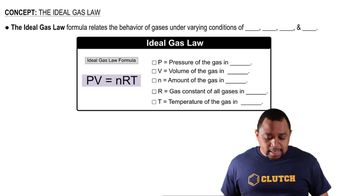
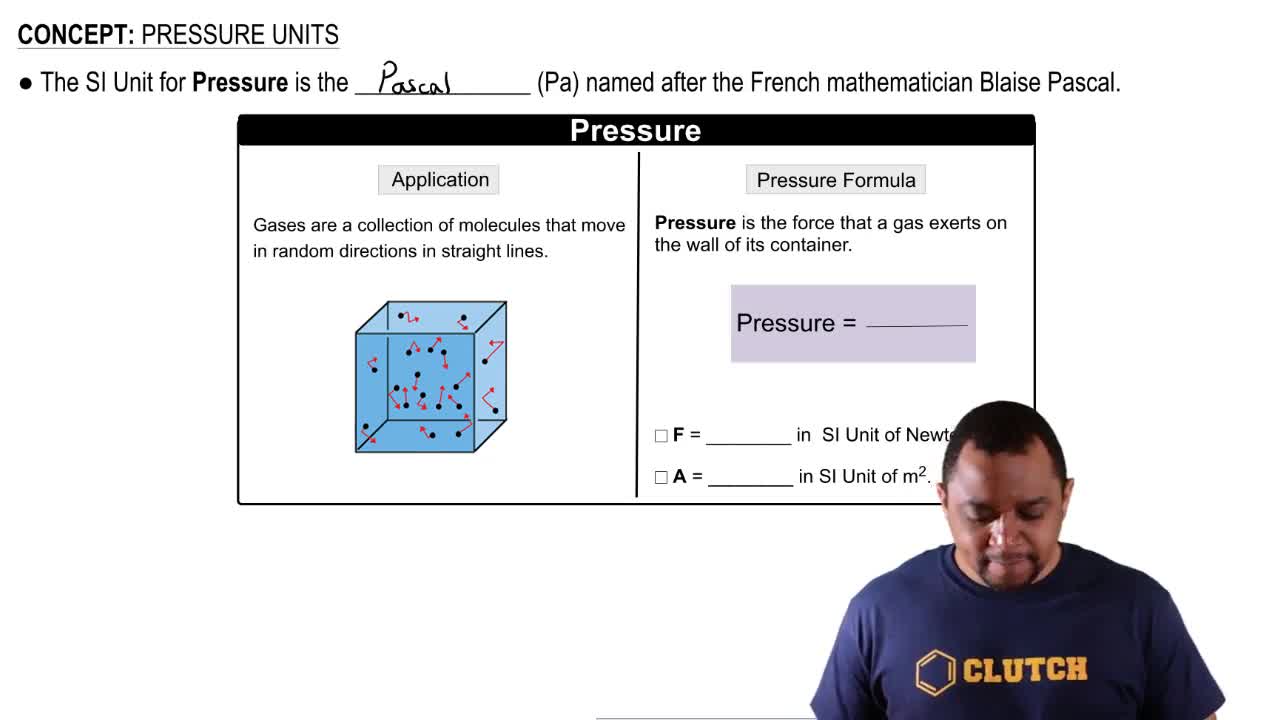
How many liters of hydrogen gas are formed from the complete reaction of 22.5 g C? Assume that the hydrogen gas is collected at a pressure of 1.00 atm and a temperature of 355 K.

Verified step by step guidance
Consider the chemical reaction:
C(s) + H2O(g) → CO(g) + H2(g)
How many liters of hydrogen gas are formed from the complete reaction of 22.5 g C? Assume that the hydrogen gas is collected at a pressure of 1.00 atm and a temperature of 355 K.
A heliox deep-sea diving mixture contains 2.0 g of oxygen to every 98.0 g of helium. What is the partial pressure of oxygen when this mixture is delivered at a total pressure of 8.5 atm?
The hydrogen gas formed in a chemical reaction is collected over water at 30.0 °C at a total pressure of 732 mmHg. What is the partial pressure of the hydrogen gas collected in this way? If the total volume of gas collected is 722 mL, what mass of hydrogen gas is collected?
The zinc in a copper-plated penny will dissolve in hydrochloric acid if the copper coating is filed down in several spots (so that the hydrochloric acid can get to the zinc). The reaction between the acid and the zinc is 2 H+(aq) + Zn(s) → H2(g) + Zn2+(aq). When the zinc in a certain penny dissolves, the total volume of gas collected over water at 25 °C is 0.951 L at a total pressure of 748 mmHg. What mass of hydrogen gas is collected?
A gas mixture contains 1.05 g N2 and 1.35 g O2 in a 1.35-L container at 15°C. Calculate the mole fraction and partial pressure of each component in the gas mixture.
What is the mole fraction of oxygen gas in air (see Table 6.3)? What volume of air contains 20.0 g of oxygen gas at 273 K and 1.00 atm?