The pressure on top of Mount Everest (29,029 ft) averages about 235 mmHg. Convert this pressure to each indicated unit. a. torr b. psi c. in Hg d. atm
Ch.6 - Gases

Chapter 6, Problem 25d
The pressure in Denver, Colorado (elevation 5280 ft), averages about 24.9 in Hg. Convert this pressure to each indicated unit. d. Pa
Verified step by step guidance1
Start by understanding the units involved: 1 inch of mercury (in Hg) is a unit of pressure commonly used in meteorology and aviation. We need to convert this to Pascals (Pa), which is the SI unit for pressure.
Use the conversion factor: 1 in Hg = 3386.39 Pa. This conversion factor is derived from the density of mercury and the acceleration due to gravity.
Multiply the given pressure in inches of mercury by the conversion factor to convert it to Pascals. So, calculate 24.9 in Hg * 3386.39 Pa/in Hg.
Ensure that the units cancel out correctly, leaving you with the pressure in Pascals.
The result from the multiplication will give you the pressure in Pascals.

Verified video answer for a similar problem:
This video solution was recommended by our tutors as helpful for the problem above.
Video duration:
1mWas this helpful?
Key Concepts
Here are the essential concepts you must grasp in order to answer the question correctly.
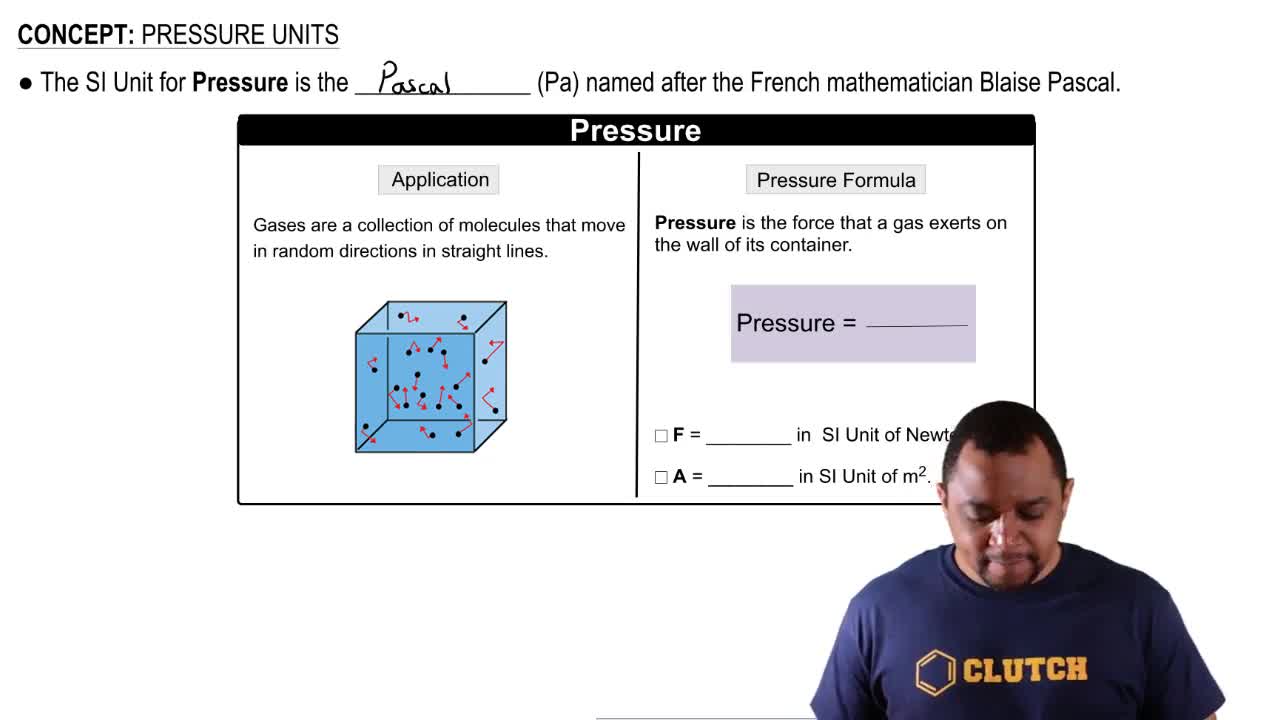
Pressure Units
Pressure is a measure of force applied per unit area and can be expressed in various units, including inches of mercury (in Hg), pascals (Pa), and atmospheres (atm). Understanding how to convert between these units is essential for solving pressure-related problems in chemistry and physics.
Recommended video:
Guided course
Pressure Units
Conversion Factors
Conversion factors are ratios that express how many of one unit are equal to another unit. For example, 1 in Hg is equivalent to 3,386.39 Pa. Using these factors allows for the accurate transformation of measurements from one unit to another, which is crucial in calculations involving pressure.
Recommended video:
Guided course
Conversion Factors
Atmospheric Pressure
Atmospheric pressure is the pressure exerted by the weight of the atmosphere above a given point. At sea level, standard atmospheric pressure is defined as 101,325 Pa or 760 mm Hg. Understanding how elevation affects atmospheric pressure is important, as higher altitudes, like Denver, experience lower pressure due to the reduced weight of the air above.
Recommended video:
Guided course
Total Pressure Example
Related Practice
Textbook Question
4565
views
1
rank
Textbook Question
Given a barometric pressure of 751.5 mmHg, calculate the pressure of each gas sample as indicated by the manometer.
(a)
3686
views
1
comments
Textbook Question
The pressure in Denver, Colorado (elevation 5280 ft), averages about 24.9 in Hg. Convert this pressure to each indicated unit. a. atm
607
views
1
rank
Textbook Question
The North American record for highest recorded barometric pressure is 31.85 in Hg, set in 1989 in Northway, Alaska. Convert this pressure to each indicated unit. a. mmHg
2946
views
Textbook Question
The pressure in Denver, Colorado (elevation 5280 ft), averages about 24.9 in Hg. Convert this pressure to each indicated unit. c. psi
758
views
Textbook Question
The pressure in Denver, Colorado (elevation 5280 ft), averages about 24.9 in Hg. Convert this pressure to each indicated unit. b. mmHg
400
views