Oxygen can be converted into ozone by the action of lightning or electric sparks: 3 O2(g) ⇌ 2 O3(g)For this reaction, ∆H = +69kcal/mol (+285 kj/mol) and K = 2.68 x 10^-29 at 25 °C.Are the reactants or the products favored at equilibrium?
Verified step by step guidance
1
Identify the equilibrium constant (K) given in the problem: K = 2.68 \(\times\) 10^{-29}.
Understand that the equilibrium constant (K) indicates the ratio of the concentration of products to reactants at equilibrium.
Recognize that a very small K value (much less than 1) suggests that the reactants are favored at equilibrium.
Consider the reaction: 3 \(\text{O}\)_2(g) \(\rightleftharpoons\) 2 \(\text{O}\)_3(g). A small K value means the concentration of \(\text{O}\)_2 is much higher than \(\text{O}\)_3 at equilibrium.
Conclude that since K is extremely small, the reactants (\(\text{O}\)_2) are favored over the products (\(\text{O}\)_3) at equilibrium.
Verified video answer for a similar problem:
This video solution was recommended by our tutors as helpful for the problem above
Video duration:
1m
Play a video:
0 Comments
Key Concepts
Here are the essential concepts you must grasp in order to answer the question correctly.
Chemical Equilibrium
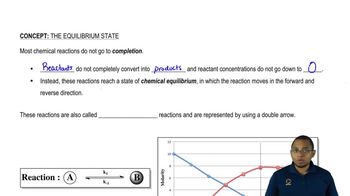
Chemical equilibrium occurs when the rates of the forward and reverse reactions are equal, resulting in constant concentrations of reactants and products. The equilibrium constant (K) quantifies the ratio of product concentrations to reactant concentrations at equilibrium. A larger K value indicates that products are favored, while a smaller K suggests that reactants are favored.
Enthalpy change (∆H) represents the heat absorbed or released during a chemical reaction at constant pressure. A positive ∆H indicates that the reaction is endothermic, meaning it requires energy input to proceed. This energy requirement can influence the position of equilibrium, often favoring reactants if the reaction absorbs significant heat.
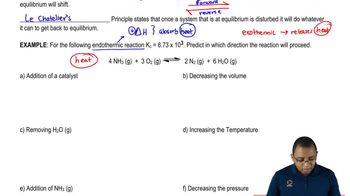
Le Chatelier's Principle states that if a system at equilibrium is disturbed by changes in concentration, temperature, or pressure, the system will adjust to counteract the disturbance and restore a new equilibrium. This principle helps predict how changes in conditions will affect the position of equilibrium, such as favoring either reactants or products based on the reaction's characteristics.

 1:04 minutes
 Verified step by step guidance
 03:42
03:42