Ammonia reacts slowly in air to produce nitrogen monoxide and water vapor: NH3(g) + O2(g) ⇌ NO(g) + H2O(g) + HeatWrite the equilibrium equation.
Verified step by step guidance
1
Identify the balanced chemical equation for the reaction. The given reaction is: \( \text{NH}_3(g) + \text{O}_2(g) \rightleftharpoons \text{NO}(g) + \text{H}_2\text{O}(g) + \text{Heat} \).
Recognize that the equilibrium constant expression \( K_c \) for a reaction is written in terms of the concentrations of the products over the reactants, each raised to the power of their stoichiometric coefficients.
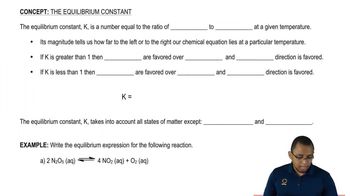
For the reaction \( aA + bB \rightleftharpoons cC + dD \), the equilibrium constant expression is \( K_c = \frac{[C]^c[D]^d}{[A]^a[B]^b} \).
Apply this concept to the given reaction. Identify the products (\( \text{NO} \) and \( \text{H}_2\text{O} \)) and reactants (\( \text{NH}_3 \) and \( \text{O}_2 \)).
Write the equilibrium expression for the reaction: \( K_c = \frac{[\text{NO}][\text{H}_2\text{O}]}{[\text{NH}_3][\text{O}_2]} \).
Verified video answer for a similar problem:
This video solution was recommended by our tutors as helpful for the problem above
Video duration:
1m
Play a video:
0 Comments
Key Concepts
Here are the essential concepts you must grasp in order to answer the question correctly.
Chemical Equilibrium
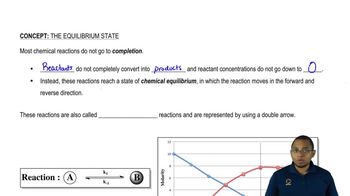
Chemical equilibrium occurs when the rates of the forward and reverse reactions are equal, resulting in constant concentrations of reactants and products. In the context of the given reaction, this means that ammonia (NH3) and oxygen (O2) are converting to nitrogen monoxide (NO) and water vapor (H2O) at a rate that balances with the reverse process, allowing the system to maintain a stable state.
The equilibrium constant (K) is a numerical value that expresses the ratio of the concentrations of products to reactants at equilibrium, each raised to the power of their coefficients in the balanced equation. For the reaction provided, K would be calculated using the concentrations of NO and H2O divided by those of NH3 and O2, reflecting the extent to which the reaction favors products or reactants at equilibrium.
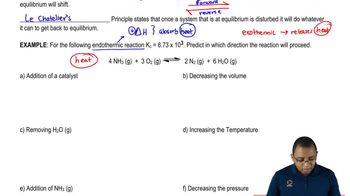
Le Chatelier's Principle states that if a dynamic equilibrium is disturbed by changing the conditions, the system will adjust to counteract the change and restore a new equilibrium. This principle is crucial for understanding how changes in concentration, temperature, or pressure can affect the position of the equilibrium in the reaction between ammonia and oxygen, influencing the amounts of NO and H2O produced.

 1:34 minutes
 Verified step by step guidance
 03:42
03:42