
Textbook Question
Match the following choices to the statements in questions 5–7:
a. IgA
b. IgD
c. IgE
d. IgG
e. IgM
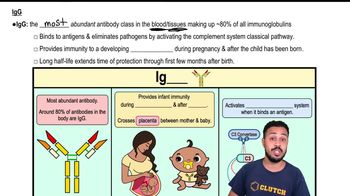
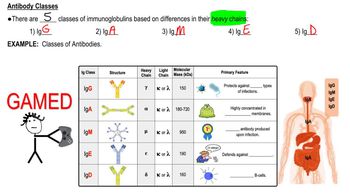
The first antibodies synthesized; especially effective against microorganisms.
910
views

 Verified step by step guidance
 04:18
04:18
 04:43
04:43Match the following choices to the statements in questions 5–7:
a. IgA
b. IgD
c. IgE
d. IgG
e. IgM
The first antibodies synthesized; especially effective against microorganisms.
Label the heavy chains, light chains, and variable and Fc regions of this typical antibody. Indicate where the antibody binds to antigen. Sketch an IgM antibody.
a. In the following graph, at time A the host was injected with tetanus toxoid. Show the response to a booster dose at time B.
b. Draw the antibody response of this same individual to exposure to a new antigen at time B.
Diagram the roles that T cells and B cells play in immunity.
Match the following choices to questions 1–4:
a. Innate resistance
b. Naturally acquired active immunity
c. Naturally acquired passive immunity
d. Artificially acquired active immunity
e. Artificially acquired passive immunity
A newborn’s immunity to yellow fever.
Explain a function for the following types of cells: CTL, TH, and Treg. What is a cytokine?