Ch. 3 - Cell Structure and Function
Bauman - Microbiology with Diseases by Taxonomy 6th Edition
Bauman6th EditionMicrobiology with Diseases by TaxonomyISBN: 9780134832302Not the one you use?Change textbook
Chapter 3, Problem 4

Which of the following is most associated with diffusion?


a. Symports
b. Antiports
c. Carrier proteins
d. Endocytosis

Verified step by step guidance
1
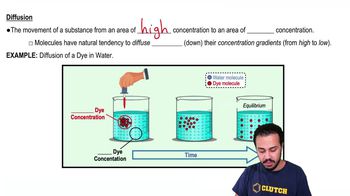
Step 1: Understand the concept of diffusion. Diffusion is the passive movement of molecules from an area of higher concentration to an area of lower concentration without the use of energy.
Step 2: Review the options given: a) Symports, b) Antiports, c) Carrier proteins, d) Endocytosis.
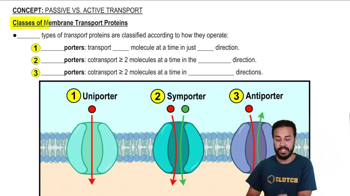
Step 3: Recognize that symports and antiports are types of active transport mechanisms that move substances against their concentration gradients, often using energy.
Step 4: Note that carrier proteins can facilitate diffusion by helping molecules cross the membrane down their concentration gradient without energy input, a process called facilitated diffusion.
Step 5: Understand that endocytosis is an energy-dependent process where cells engulf large particles or fluids, which is not related to diffusion.

Verified video answer for a similar problem:

This video solution was recommended by our tutors as helpful for the problem above.
Video duration:
3m
Was this helpful?

Key Concepts

Here are the essential concepts you must grasp in order to answer the question correctly.

Diffusion

Diffusion is the passive movement of molecules from an area of higher concentration to an area of lower concentration, without the use of energy. It is a fundamental process for the transport of small, nonpolar molecules across cell membranes.
Recommended video:

Carrier Proteins

Carrier proteins facilitate the transport of specific molecules across the cell membrane, often by changing shape. They can mediate both passive transport (facilitated diffusion) and active transport, depending on whether energy is used.
Recommended video:

Symports and Antiports

Symports and antiports are types of carrier proteins involved in active transport. Symports move two substances in the same direction, while antiports move them in opposite directions, both often using energy indirectly to move molecules against their concentration gradients.
Recommended video:
Guided course
03:28
Classes of Membrane Transport Proteins
Related Practice
Textbook Question

A "9 + 2" arrangement of microtubules is seen in __________ .


a. archaeal flagella

b. bacterial flagella

c. eukaryotic flagella

d. all prokaryotic flagella

1557
views

Textbook Question

Which of the following is true of Svedbergs?


a. They are not exact but are useful for comparisons.

b. They are abbreviated “sv.”

c. They are prokaryotic in nature but exhibit some eukaryotic characteristics.

d. They are an expression of sedimentation rate during high-speed centrifugation.

1646
views
Textbook Question

Which of the following is not a function of a glycocalyx?


a. It forms pseudopods for faster mobility of an organism.

b. It can protect a bacterial cell from drying out.

c. It hides a bacterial cell from other cells.

d. It allows a bacterium to stick to a host.

1267
views
Textbook Question

Which of the following is not associated with prokaryotic organisms?


a. Nucleoid

b. Glycocalyx

c. Cilia

d. Circular DNA

914
views
Textbook Question

A local newspaper writer has contacted you, an educated microbiology student from a respected college. He wants to obtain scientific information for an article he is writing about “life” and poses the following query: “What is the difference between a living thing and a nonliving thing?” Knowing that he will edit your material to fit the article, give an intelligent, scientific response.

1350
views
Textbook Question

The term fluid mosaic has been used in describing the cytoplasmic membrane. How does each word of that phrase accurately describe our current understanding of a cell membrane?

1296
views