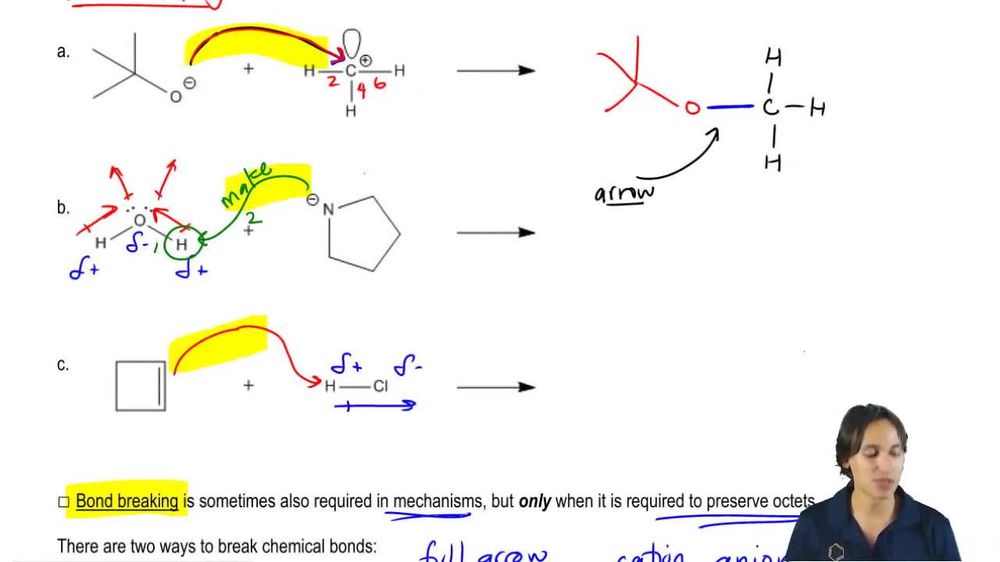
In the following reactions, identify the bonds formed and the bonds broken. (c)
Verified step by step guidance
1
Analyze the reactants: The reaction involves ethanol (CH3CH2OH) and a tertiary alkyl bromide (CH3C(Br)(Ph)CH3). Ethanol acts as a nucleophile, and the tertiary alkyl bromide undergoes a substitution reaction.
Identify the bonds broken: The C-Br bond in the tertiary alkyl bromide is broken during the reaction, resulting in the formation of a carbocation intermediate. Additionally, the O-H bond in ethanol is broken as the oxygen donates a lone pair to form a bond with the carbocation.
Identify the bonds formed: A new C-O bond is formed between the carbocation (CH3C(+)(Ph)CH3) and the oxygen atom of ethanol. Additionally, a Br⁻ ion is released as a result of the C-Br bond cleavage.
Examine the products: The reaction produces a protonated ether (CH3CH2O⁺H), a bromide ion (Br⁻), and an alkene (CH2=C(Ph)CH3). The alkene forms due to elimination of a proton from the carbocation intermediate.
Summarize the reaction mechanism: This reaction proceeds via an SN1 mechanism, where the tertiary alkyl bromide first forms a carbocation intermediate. Ethanol acts as a nucleophile, attacking the carbocation to form the ether. Simultaneously, elimination occurs to produce the alkene.
Verified video answer for a similar problem:
This video solution was recommended by our tutors as helpful for the problem above
Play a video:
0 Comments
Key Concepts
Here are the essential concepts you must grasp in order to answer the question correctly.
Nucleophilic Substitution
Nucleophilic substitution is a fundamental reaction in organic chemistry where a nucleophile attacks an electrophile, resulting in the replacement of a leaving group. In this reaction, the hydroxide ion (OH-) acts as a nucleophile, attacking the carbon atom bonded to bromine (Br), which is the leaving group. Understanding this concept is crucial for identifying which bonds are broken and formed during the reaction.
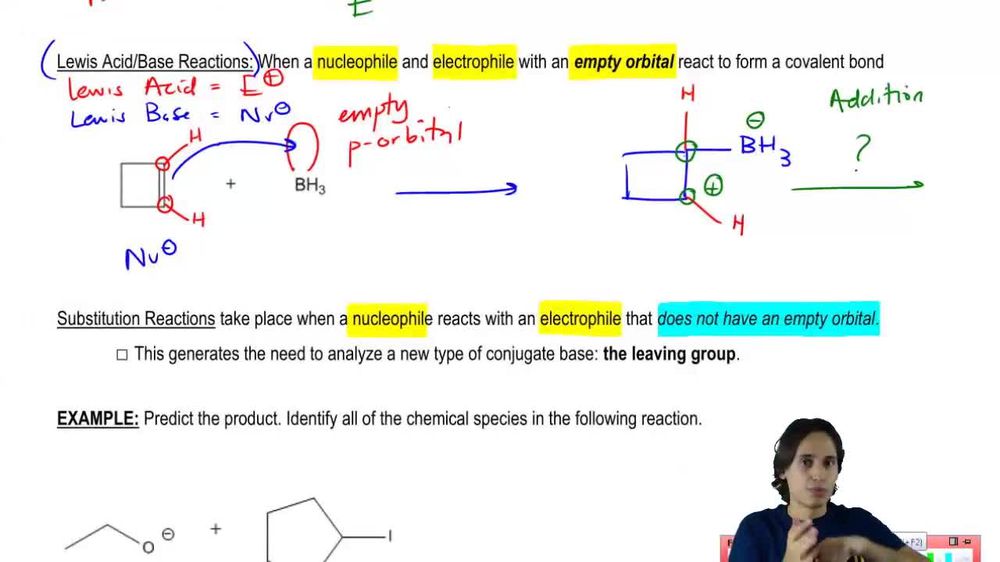
Nucleophiles and Electrophiles can react in Substitution Reactions.
Bond Formation and Breaking
In chemical reactions, bonds are both formed and broken. In the given reaction, the C-Br bond is broken as bromine leaves, while a new C-O bond is formed when the hydroxide ion attaches to the carbon atom. Recognizing which specific bonds are involved helps in predicting the products and understanding the mechanism of the reaction.
A reaction mechanism describes the step-by-step process by which reactants are converted into products. It includes details about the intermediates formed and the transition states. In this case, the mechanism involves the nucleophilic attack of the hydroxide ion on the carbon atom, leading to the formation of an alkoxide intermediate before the final products are generated. Understanding the mechanism is essential for grasping the overall reaction dynamics.